
Top test designers for easy and effective A/B testing
Choosing the right test designer tool can feel overwhelming when you're trying to run effective A/B tests without a data science team. Most SMB marketers need simple, powerful solutions that deliver reliable results without requiring advanced statistical knowledge. This guide walks you through a practical framework for evaluating test designers, comparing top options, and selecting the best fit for your business goals and traffic levels.
Table of Contents
- Key takeaways
- Criteria for choosing the right test designer
- Top test designer options for small to medium businesses
- Emerging AI-powered test designers: capabilities and caveats
- Comparison of test designers: choosing the best fit for your business
- Discover streamlined A/B testing with GoStellar
- FAQ
Key Takeaways
| Point | Details |
|---|---|
| Qualitative research foundation | Successful A/B testing starts with heatmaps, session recordings, and user feedback to identify genuine friction points. |
| A A test validation | Baseline A A tests confirm your tool is not producing false positives before live campaigns. |
| Statistical approach matters | Frequentist methods require fixed sample sizes while Bayesian sequential testing lets you monitor results as data arrives, improving flexibility for low traffic. |
| Prioritize usability | Choose visual editors and clear dashboards so your team can build and review tests without extra friction. |
Criteria for choosing the right test designer
Selecting a test designer starts long before you compare feature lists or pricing tiers. The foundation of successful A/B testing lies in qualitative research that informs your hypotheses. Before running any split test, examine heatmaps, watch session recordings, and gather user feedback to identify genuine friction points. This groundwork ensures you're testing elements that actually matter to your visitors.
Once you've identified what to test, validate your testing infrastructure with A/A tests. These baseline tests compare identical versions to confirm your tool isn't producing false positives. Many marketers skip this step and end up chasing phantom wins that never materialize in real campaigns.
The statistical approach your test designer uses fundamentally shapes how you interpret results. Frequentist methods require predetermined sample sizes and strict stopping rules, which can frustrate SMBs with variable traffic. Bayesian approaches allow sequential testing, letting you check results as data accumulates without inflating error rates. For businesses with under 50,000 monthly visitors, sequential testing methods provide flexibility without sacrificing statistical validity.
Pro Tip: Focus your first tests on high-impact elements like headlines, primary CTAs, and form fields. These changes typically show measurable results faster than subtle design tweaks, helping you build confidence in your testing process.
Usability matters more than you might expect. A test designer with advanced features you never use creates friction instead of value. Look for visual editors that let you create variations without writing code, clear dashboards that surface insights quickly, and integration capabilities that connect with your existing marketing stack. The best tool is the one your team will actually use consistently.
Top test designer options for small to medium businesses
Several test designers have emerged as strong choices for SMB marketers who need reliable results without enterprise complexity. These platforms balance statistical rigor with user-friendly interfaces, making them accessible to teams without dedicated analysts.

Sequential Bayesian platforms lead the pack for low-traffic businesses. These tools continuously update probability estimates as new data arrives, showing you the likelihood that variation B outperforms variation A. Unlike traditional frequentist tools that demand you wait for predetermined sample sizes, Bayesian test designers let you make informed decisions when confidence reaches acceptable thresholds. This flexibility proves invaluable when you're testing high-impact elements like signup forms where every conversion matters.
Visual editors have become table stakes for modern test designers. The ability to point, click, and modify page elements dramatically reduces the time from hypothesis to live test. Look for platforms that handle dynamic content, support multi-page experiments, and preview variations before launch. These features prevent the frustrating cycle of launching tests, discovering implementation errors, and starting over.
Getting started with most SMB-focused test designers follows a similar pattern:
- Install a lightweight tracking script on your site
- Use the visual editor to select elements you want to test
- Create variations that address specific hypotheses from your qualitative research
- Set clear success metrics tied to business outcomes
- Launch sequential tests that accumulate data until reaching statistical confidence
The strongest platforms for SMBs share common characteristics. They minimize performance impact with small script sizes, typically under 10KB. They provide real-time analytics so you can monitor test health without waiting for daily reports. They offer straightforward pricing based on traffic volume rather than confusing feature tiers. Most importantly, they help you validate marketing ideas quickly so you can iterate faster than competitors.
Consider the tradeoffs carefully. Simple tools get you testing faster but may lack advanced segmentation or multivariate capabilities. More sophisticated platforms offer deeper analysis but require steeper learning curves. For most SMBs starting their testing journey, simplicity wins. You can always graduate to more complex tools as your experimentation program matures.
Emerging AI-powered test designers: capabilities and caveats
Artificial intelligence is reshaping how marketers approach test design, though the technology remains in early stages. Current AI-powered testing tools excel at generating variation ideas and hypotheses based on historical data patterns. These systems analyze past experiments, identify winning elements, and suggest new combinations worth testing.
The hypothesis generation capabilities prove particularly valuable when you're stuck for ideas. AI test designers can review your landing page, compare it against thousands of successful examples in their training data, and propose specific changes with predicted impact scores. This accelerates the ideation phase that often bottlenecks testing programs.
Several platforms now integrate AI directly into their testing workflows. Some CRM systems include built-in AI agents that monitor campaign performance and automatically suggest A/B tests for underperforming segments. Others offer standalone tools that connect via API to your existing marketing stack, providing a layer of intelligence without requiring platform migration.
Pro Tip: Treat AI-generated test ideas as starting points, not gospel. Always validate suggestions against your qualitative research and business context before investing resources in building and running experiments.
The critical limitation of current AI test designers lies in validation. Machine learning models can spot patterns and generate creative variations, but they cannot replace the rigorous testing needed to confirm those ideas actually improve outcomes. False positives remain a significant risk when AI systems make recommendations based on correlation rather than causation.
"AI integration is emerging for hypothesis generation, but real test validation remains necessary to separate genuine insights from algorithmic artifacts."
Maintaining human oversight prevents costly mistakes. Review AI suggestions through the lens of your customer knowledge, brand guidelines, and strategic priorities. Use AI to expand your testing pipeline, but apply your judgment to prioritize which experiments deserve immediate attention. The most effective approach combines AI's pattern recognition with human intuition about what resonates with your specific audience.
Workflow integration determines how much value you extract from AI test designers. Tools that seamlessly connect with your experiment design process save time and reduce friction. Look for platforms that automatically populate variation content, generate test documentation, and track which AI suggestions produced winning results. This feedback loop helps the AI improve recommendations over time.
Comparison of test designers: choosing the best fit for your business
Comparing test designers requires evaluating multiple dimensions beyond surface-level features. The right choice depends on your traffic volume, team capabilities, testing maturity, and specific business goals.
| Feature | Sequential Bayesian Tools | Traditional Frequentist Tools | AI-Powered Platforms |
|---|---|---|---|
| Best for traffic level | Under 100K monthly visitors | Over 100K monthly visitors | Any level with historical data |
| Statistical approach | Continuous probability updates | Fixed sample size required | Varies by platform |
| Ease of use | High (visual editors) | Medium (some coding) | High (automated suggestions) |
| Ideal user | SMB marketers | Enterprise teams | Growth hackers |
| Key strength | Flexibility and speed | Statistical rigor | Idea generation |
Traffic volume serves as the primary decision filter. Businesses with limited monthly visitors benefit most from sequential testing approaches that reach conclusions faster. Traditional frequentist tools work well for high-traffic sites where reaching predetermined sample sizes happens quickly, but they frustrate smaller businesses that might wait months for statistically significant results.
Team capacity shapes which features actually deliver value. A sophisticated multivariate testing platform wastes resources if your team only runs simple A/B tests. Conversely, a bare-bones tool limits growth when you're ready for more complex experiments. Assess your current testing frequency honestly, then choose a platform that supports your next stage of maturity without overwhelming your present capabilities.
Consider these factors when making your final selection:
- Implementation complexity and time to first test
- Performance impact on page load speeds
- Integration with existing analytics and marketing tools
- Quality of documentation and customer support
- Pricing structure and scalability as traffic grows
- Advanced features you'll need within 12 months
The statistical rigor question deserves careful thought. While Bayesian methods offer practical advantages for SMBs, understanding the underlying approach helps you interpret results correctly. Some platforms provide both options, letting you choose based on specific test requirements. This flexibility proves valuable as you develop more sophisticated testing strategies over time.
Match tool complexity to your organizational readiness. Starting with an overly complex platform often leads to abandoned testing programs when teams feel overwhelmed. Begin with tools that remove friction from the testing process, then graduate to more advanced options as experimentation becomes embedded in your culture. The best test designer is the one that helps you run more experiments, not the one with the longest feature list.
Discover streamlined A/B testing with GoStellar
Finding the right test designer transforms how quickly you can validate ideas and improve conversion rates. GoStellar combines the simplicity SMB marketers need with the statistical rigor that ensures reliable results. Our lightweight 5.4KB script delivers fast performance while our visual editor lets you create variations in minutes, not hours.
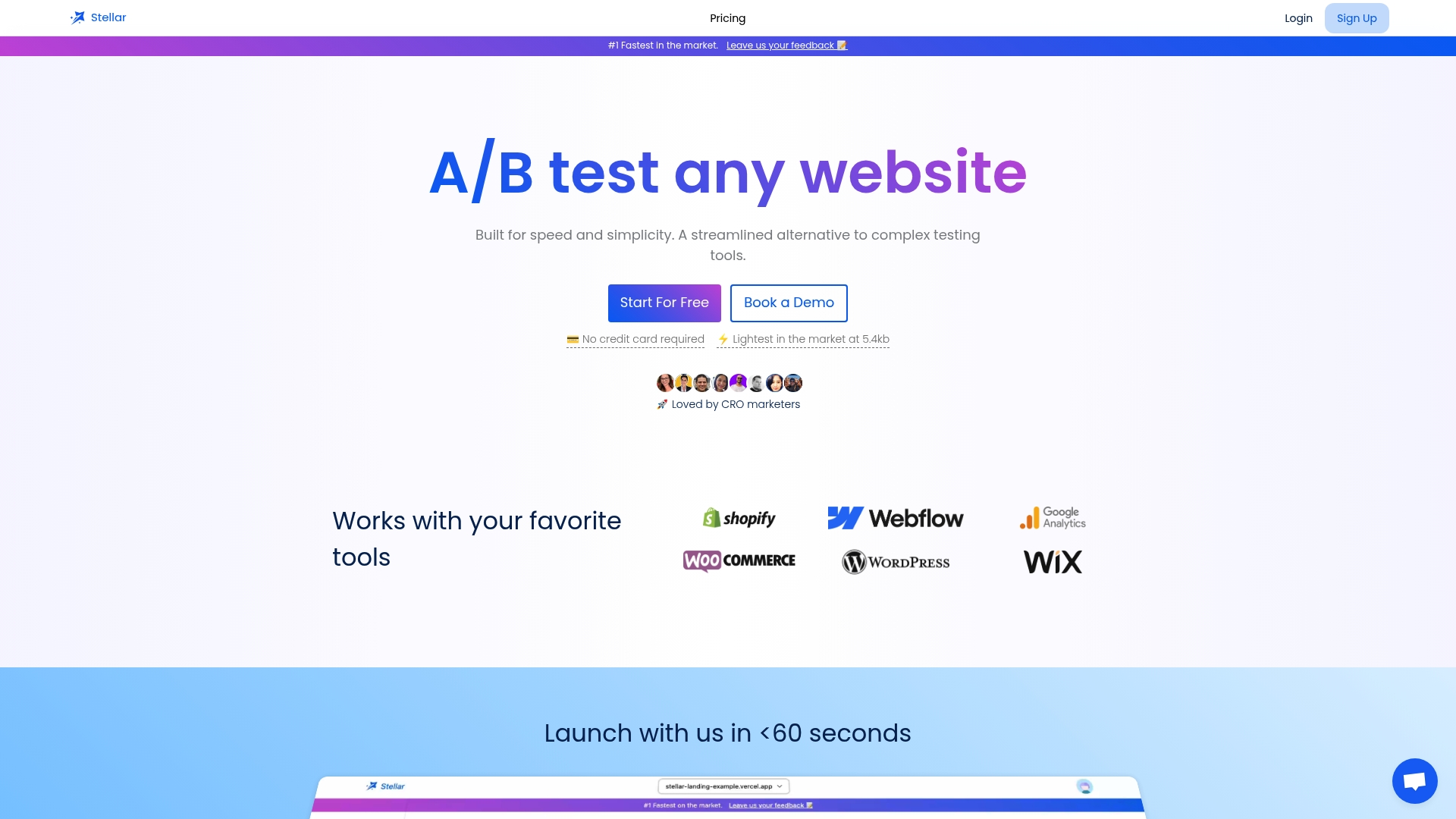
Whether you're running your first A/B test or scaling an established experimentation program, GoStellar provides the tools to make confident, data-driven decisions. Start optimizing your campaigns today with a platform built specifically for marketers who value both speed and accuracy. Visit GoStellar to explore how easy effective testing can be.
FAQ
What is a test designer in A/B testing?
A test designer is a tool or methodology that helps you create, implement, and manage split tests on your website or marketing campaigns. It handles the technical aspects of randomly assigning visitors to variations, tracking their behavior, and calculating statistical significance. The best test designers combine ease of use with sound statistical methods, letting marketers focus on generating insights rather than managing technical details.
How do I choose the best test designer for my small business?
Prioritize tools optimized for lower traffic volumes that use sequential or Bayesian testing methods. Look for platforms with visual editors that don't require coding skills and clear dashboards that surface insights quickly. Consider your budget, integration needs, and how much support you'll need during implementation. Review A/B testing best practices to understand which features matter most for your testing goals.
Can AI test designers replace human judgment?
AI accelerates hypothesis generation and variation creation but cannot replace the validation process that confirms ideas actually work. AI-assisted tools help you test more ideas faster by suggesting variations based on pattern recognition, but human oversight remains essential to avoid false positives and ensure suggestions align with brand guidelines and business strategy. Use AI to expand your testing pipeline while maintaining control over which experiments you prioritize and how you interpret results.
How long should I run an A/B test?
Test duration depends on your traffic volume, conversion rates, and the statistical approach your test designer uses. Sequential Bayesian tools let you monitor results continuously and stop when confidence thresholds are met, often reaching conclusions in days or weeks. Traditional frequentist methods require running tests until predetermined sample sizes are reached, which might take months for low-traffic sites. Never stop tests early based on initial results, as this inflates false positive rates and leads to unreliable conclusions.
What elements should I test first as a beginner?
Start with high-impact elements that directly influence conversion decisions: headlines, primary call-to-action buttons, form fields, and value propositions. These elements typically show measurable results faster than subtle design changes, helping you build confidence in your testing process. Focus on one element at a time so you can clearly attribute results to specific changes, then gradually expand to more complex multivariate experiments as your program matures.
Recommended
Published: 3/24/2026