
Types of Conversion Objectives: Boost A/B Tests by 40%
Nearly 60% of A/B tests fail to deliver actionable insights because marketers track the wrong conversion objectives. When your objectives don't align with user intent and business goals, you're essentially running experiments in the dark. This guide breaks down the critical types of conversion objectives and shows you exactly how to select and apply them for tests that actually move the needle.
Table of Contents
- Understanding Conversion Objective Types
- Framework for Categorizing Conversion Objectives
- Common Misconceptions About Conversion Objectives
- Framework for Selecting Conversion Objectives
- Applying Conversion Objectives in A/B Testing
- Case Studies of Conversion Objective Strategies
- Enhance Your A/B Testing With Our Expert Resources
- Types of Conversion Objectives FAQ
Key Takeaways
| Point | Details |
|---|---|
| Conversion objectives split into macro and micro types tied to specific funnel stages | Macro conversions drive revenue directly while micro conversions indicate funnel progression |
| Aligning objectives with user intent clarifies test insights and maximizes impact | Proper alignment reduces wasted testing cycles and accelerates optimization velocity |
| Tracking too many objectives simultaneously dilutes insights and complicates analysis | Focus on 3 to 5 well-chosen objectives per test to maintain clarity |
| SMART criteria ensures objectives remain measurable, achievable, and business-relevant | This framework prevents vague goals that yield inconclusive results |
| Micro conversions boost funnel progression metrics by up to 70% | These indicators provide early signals before macro conversion changes become statistically significant |
Understanding Conversion Objective Types
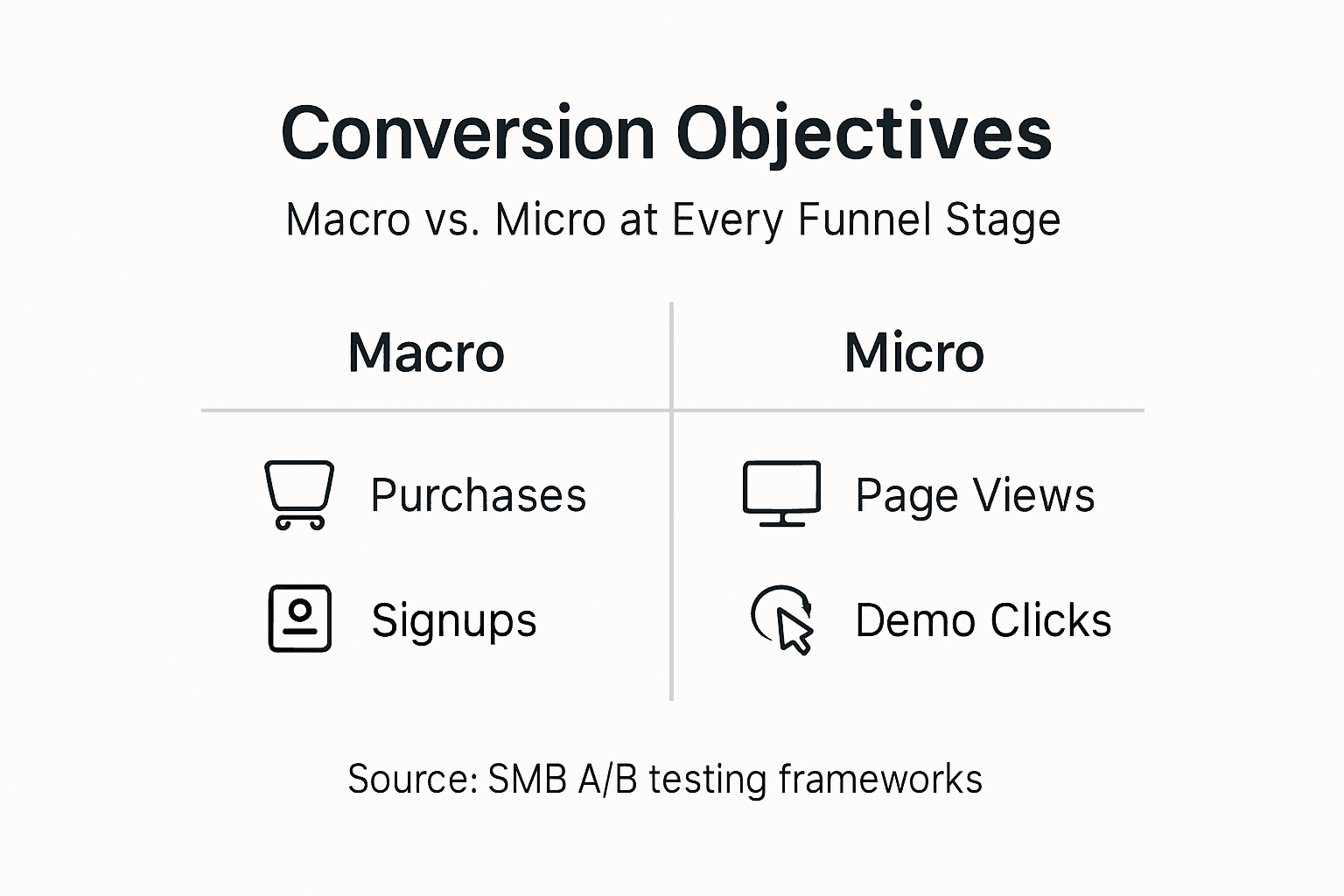
Conversion objectives fall into two fundamental categories that shape how you measure A/B test success. Macro conversions represent the final, revenue-impacting actions users take on your site. These include completed purchases, signed contracts, or subscription upgrades. They sit at the bottom of your funnel and directly affect your bottom line.
Micro conversions capture the smaller engagement steps that lead users toward those final actions. Think email signups, product page visits, add-to-cart clicks, or video views. While they don't immediately generate revenue, they signal user interest and funnel movement. For SMBs, tracking both types provides a complete picture of user behavior.
Common SMB macro objectives include:
- Completed product purchases
- Free trial to paid conversions
- Demo request submissions
- Quote form completions
Common micro objectives include:
- Newsletter signups
- Resource downloads
- Product comparison tool usage
- Chatbot engagement
These objectives map directly to user journey stages. Awareness stage objectives focus on initial engagement. Consideration stage objectives track deeper exploration behaviors. Decision stage objectives measure final commitment actions. Understanding conversion funnels helps you identify which stage needs the most attention.
Your hypothesis formation relies heavily on choosing the right objective type. Testing a headline change? Micro conversions like time-on-page work well. Testing a new checkout flow? Your macro conversion rate is the primary metric. The key is matching the objective to the element you're testing and the funnel stage it influences.
Proper marketing funnel optimization starts with setting conversion goals that reflect genuine user progression through each stage.
Framework for Categorizing Conversion Objectives
Mapping conversion objectives to marketing funnel stages creates a strategic blueprint for test planning. Each funnel stage reflects different user intent levels and requires distinct objective types. This framework prevents the common mistake of applying decision-stage metrics to awareness-stage tests.
At the Awareness stage, users are just discovering your solution. Objectives here focus on engagement and initial interest signals. Track metrics like page scroll depth, blog post reads, or social share clicks. These indicate whether your content resonates with cold traffic.

The Consideration stage captures users actively evaluating your offer against alternatives. Appropriate objectives include pricing page visits, feature comparison tool usage, or case study downloads. These actions show users moving from casual interest to serious evaluation.
Decision stage objectives measure commitment readiness. Free trial starts, demo bookings, add-to-cart actions, and purchase completions all signal users ready to convert. These objectives carry the highest business impact but often require the longest time to show statistical significance.
Here's how typical SMB objectives align by funnel stage:
| Funnel Stage | User Intent | Example Objectives | Typical Conversion Rate |
|---|---|---|---|
| Awareness | Information seeking | Blog engagement, video views | 15% to 25% |
| Consideration | Solution evaluation | Pricing page visits, tool trials | 8% to 15% |
| Decision | Purchase readiness | Checkout starts, demo requests | 2% to 5% |
Choosing funnel-aligned objectives brings immediate clarity to your testing program. You'll know exactly which user behaviors to influence and can design variations that specifically address barriers at each stage. This alignment also helps you communicate test results to stakeholders using language tied to business outcomes.
Understanding conversion funnels and applying marketing funnel optimization principles ensures your objectives reflect real user progression.
Pro Tip: Before defining objectives for any test, identify which funnel stage represents your biggest bottleneck. Use analytics to find where most users drop off, then prioritize objectives at that exact stage. This focuses your optimization efforts where they'll deliver maximum impact.
Common Misconceptions About Conversion Objectives
Three persistent myths sabotage conversion objective selection and lead marketers to make costly mistakes. Clearing up these misconceptions will immediately improve your A/B testing strategy and results.
Myth 1: Purchase optimization alone suffices for complete funnel health. Many marketers fixate exclusively on macro conversions, assuming that improved sales numbers mean everything else is working. This creates blind spots. Users might abandon your funnel at earlier stages, meaning you never get enough qualified traffic reaching your optimized checkout. A multi-stage focus identifies where users actually struggle, not just where they finally give up.
Myth 2: Tracking more objectives produces clearer, more actionable results. This seems logical but fails in practice. When you track ten different objectives per test, you fragment your analysis and dilute statistical power. You'll struggle to determine which metric truly matters and may draw conflicting conclusions. Worse, you increase the risk of false positives through multiple comparison problems. Keep your objective count tight and purposeful.
Myth 3: Micro conversions don't matter if you focus primarily on sales. Data tells a different story. Research shows micro conversions drive roughly 70% of funnel progression metrics, acting as leading indicators before macro changes become measurable. They also reach statistical significance faster due to higher volume, letting you iterate more quickly. Ignoring them means waiting weeks for macro conversion data while missing early warning signs.
"Tracking only macro conversions is like driving by only watching your destination on the map while ignoring the road ahead. You need both to navigate successfully." - Conversion optimization expert insight
Poor prioritization hits SMBs especially hard because of resource constraints. You can't afford to run underpowered tests or wait months for conclusive results. Balanced, prioritized objective tracking ensures every test cycle generates valid insights you can actually use. Focus beats breadth every single time.
Framework for Selecting Conversion Objectives
Selecting the right conversion objectives requires a systematic approach that balances business needs with testing practicality. The SMART framework provides the foundation: objectives must be Specific, Measurable, Achievable, Relevant, and Time-bound. This prevents vague goals like "improve engagement" that yield inconclusive results.
Start with these key selection criteria. First, verify business goal alignment. Your conversion objective should directly support a current business priority, whether that's revenue growth, user acquisition, or retention improvement. Second, confirm measurability. You need clean, reliable data capture for the objective. Third, assess user behavior relevance. The objective should reflect meaningful user actions, not arbitrary metrics.
Trade-offs emerge when choosing between single and multiple objectives. A single primary objective keeps analysis simple and maintains statistical power. Multiple objectives provide richer insights but require larger sample sizes and more complex analysis. For most SMB tests, one primary objective plus one to two secondary objectives strikes the right balance.
Limit yourself to three to five objectives maximum per test. This constraint forces prioritization and maintains focus. Rank objectives by business impact and choose those that directly inform your optimization decisions. Everything else is noise.
Your selection checklist:
- Does this objective align with our current business priority?
- Can we accurately measure it with existing tools?
- Does it reflect meaningful user behavior?
- Will it reach statistical significance within our test timeline?
- Can we take concrete action based on the results?
Proper set conversion goals practices and thoughtful choosing conversion actions ensure your objectives drive real business outcomes.
Pro Tip: Before launching any test, document your objective rationale and success metrics in a one-page brief. Write down why you chose each objective, what result would constitute success, and what action you'll take based on each possible outcome. This clarity prevents mid-test confusion and ensures stakeholder alignment from day one.
Applying Conversion Objectives in A/B Testing
Putting conversion objectives into practice requires matching test design to objective type while leveraging the right measurement tools. Real implementation separates successful optimization programs from those that spin their wheels.
For macro conversion tests, focus your variations on elements that directly influence purchase decisions. Test checkout flows, pricing presentations, guarantee statements, or final call-to-action copy. These high-impact areas justify the longer wait times needed for macro conversion data to reach significance. Your sample size requirements will be higher because macro conversions typically have lower base rates.
Micro conversion tests let you move faster. Test top-of-funnel elements like headlines, hero images, navigation layouts, or content organization. With higher event volumes, you'll reach statistical significance in days rather than weeks. Use these quick wins to build momentum and validate broader hypotheses before committing to major redesigns.
Advanced techniques amplify results. Dynamic keyword insertion personalizes landing pages based on search terms, boosting relevance and micro conversion rates. Personalization based on traffic source, device type, or returning visitor status helps you optimize for specific user segments. These tactics work especially well for micro conversion objectives where you're optimizing engagement rather than final purchases.
Micro conversions serve as leading indicators that predict macro conversion changes before they become statistically measurable. If you see email signups jumping 30% while purchases remain flat, you know interest is building. Give it time and the macro numbers will follow. This early signal lets you continue winning variations with confidence even before revenue impact shows up.
Here's how different objective types map to tracking techniques for SMB scenarios:
| Objective Type | Tracking Method | Typical Sample Size Needed | Time to Significance |
|---|---|---|---|
| Macro (Purchase) | Revenue tracking, transaction IDs | 1,000+ per variation | 2 to 4 weeks |
| Micro (Signup) | Event tracking, form submissions | 300+ per variation | 3 to 7 days |
| Engagement | Scroll depth, time on page | 500+ per variation | 5 to 10 days |
| Navigation | Click tracking, page flow | 400+ per variation | 5 to 10 days |
Modern goal tracking tools enable precise measurement across objective types. Look for platforms offering real-time analytics, custom event tracking, and funnel visualization. These capabilities let you monitor multiple objectives simultaneously without losing clarity. When setting conversion goals and choosing conversion actions, prioritize tools that make tracking setup simple and reporting transparent.
Understanding the psychology behind conversions and properly designing experiments ensures your objective implementation matches user behavior patterns. For deeper insights into email testing specifically, explore this email A/B testing guide that covers objective selection for email campaigns.
Case Studies of Conversion Objective Strategies
Real-world examples demonstrate how strategic objective selection transforms A/B testing outcomes for SMBs. These case studies reveal both the upside of getting it right and the costs of getting it wrong.
A SaaS startup initially tracked only free trial signups as their conversion objective. Tests showed consistent improvements in trial numbers, but paid conversions stayed flat. After redefining their primary objective to focus on trial-to-paid conversion rate and adding micro objectives around feature usage during trials, they discovered onboarding friction was killing conversions. The new objective framework led to a 33% uplift in paying customers within eight weeks. The lesson: your objectives must reflect the actual behavior driving business results, not just top-of-funnel vanity metrics.
An e-commerce SMB made the opposite mistake by tracking twelve different objectives per test, from page views to purchases to social shares. Analysis paralysis set in. Some objectives improved while others declined, making it impossible to declare clear winners. Worse, their bounce rate increased 20% because they optimized for engagement metrics that encouraged browsing rather than buying. They eventually narrowed focus to three core objectives: add-to-cart rate, checkout completion, and average order value. Clarity returned and their optimization velocity doubled.
A B2B services company implemented multi-objective tracking that balanced macro and micro conversions. Their primary objective remained demo requests, but they added secondary objectives for pricing page visits and case study downloads. This revealed that visitors who downloaded case studies converted to demos at three times the baseline rate. They redesigned their funnel to promote case studies earlier, resulting in 45% more qualified demo requests. The insight came from tracking the right mix of leading and lagging indicators.
Key takeaways for your SMB tests:
- Match objectives to actual business drivers, not surface-level engagement
- Limit tracked objectives to maintain analytical clarity
- Balance macro objectives with micro indicators for faster learning
- Use objective insights to identify high-value user paths through your funnel
Strategic goal tracking in CRO amplifies these benefits by ensuring consistent measurement across all optimization efforts.
Enhance Your A/B Testing with Our Expert Resources
Mastering conversion objectives is just the beginning of building a high-performing testing program. The strategies covered here work best when paired with proper execution frameworks and the right testing platform.
Our comprehensive guides walk you through every aspect of effective A/B testing for SMBs. Explore A/B testing best practices for foundational principles that complement your conversion objective strategy. When you're ready to optimize specific pages, our A/B testing for landing pages guide provides detailed tactics. Compare platforms and features in our top A/B testing platforms roundup to find tools that match your objective tracking needs perfectly.
Types of Conversion Objectives FAQ
What is the difference between macro and micro conversion objectives?
Macro conversions are final revenue-generating actions like purchases, subscriptions, or contract signings that directly impact your bottom line. Micro conversions are smaller engagement steps such as email signups, page visits, or content downloads that indicate funnel progression toward those final actions. Tracking both provides complete visibility into user behavior and optimization opportunities.
How do I decide which conversion objective to prioritize in my A/B test?
Prioritize objectives that align with your current business goal and the funnel stage you're testing. Use analytics to identify your biggest conversion bottleneck, then select objectives at that specific stage. Choose objectives that will reach statistical significance within your available traffic and timeline, typically favoring micro conversions for faster iteration unless you're specifically optimizing final purchase flows.
Can tracking multiple conversion objectives reduce test clarity?
Yes, tracking too many objectives dilutes statistical power and creates analysis paralysis. When results conflict across objectives, determining clear winners becomes nearly impossible. Limit yourself to one primary objective and two to three secondary objectives maximum per test to maintain focus and actionable insights.
Why are micro conversions important even if I focus on sales?
Micro conversions drive approximately 70% of funnel progression metrics and serve as leading indicators that predict macro conversion changes before they become statistically measurable. They reach significance faster due to higher volume, letting you iterate quickly. Ignoring them means missing early signals and waiting weeks for macro data while optimization opportunities pass by.
How do conversion objectives relate to the marketing funnel stages?
Each funnel stage requires different objective types matching user intent levels. Awareness stage objectives measure initial engagement like content views. Consideration stage objectives track evaluation behaviors like pricing page visits. Decision stage objectives capture commitment actions like purchases or signups. Aligning objectives with funnel stages ensures you measure behaviors relevant to each user journey phase and can identify exactly where optimization efforts will deliver maximum impact.
Recommended
Published: 2/28/2026