
Unlock higher conversions with dynamic landing pages
TL;DR:
- Dynamic landing pages adapt content in real-time based on visitor data such as location, intent, and device, personalizing elements like headlines and CTAs without creating multiple static pages. They improve conversions by delivering highly relevant experiences but require careful management of triggers, testing, and fallback content to prevent technical and SEO issues. Effective use hinges on strategic hypothesis testing, standardized data collection, and user-friendly platforms that enable quick customization and analysis.
Static landing pages made sense when everyone online looked the same. They don't anymore. Today's visitors arrive from dozens of different channels, devices, locations, and intent levels, and a single static page tries to speak to all of them equally. That's a conversion killer. Dynamic landing pages adapt content in real-time based on visitor data such as location, intent, device, UTM parameters, or CRM signals, personalizing elements like headlines, CTAs, images, and testimonials without creating multiple static pages. This article breaks down how dynamic pages work, what can go wrong, and how to test them so you actually see results.
Table of Contents
- What is a dynamic landing page?
- How dynamic personalization works: The core triggers
- Pitfalls and technical edge cases: When does dynamic fail?
- Best practices for A/B testing dynamic landing pages
- A marketer's take: What most people get wrong about dynamic landing pages
- How to put dynamic landing pages to work for you
- Frequently asked questions
Key Takeaways
| Point | Details |
|---|---|
| What dynamic pages do | Dynamic landing pages instantly tailor content to each visitor using real-time data. |
| Core triggers matter | Personalization works best when based on UTM, device, location, or CRM data used thoughtfully. |
| Beware technical pitfalls | Poor tracking, over-personalization, and SEO risks can hurt more than help if not addressed. |
| Test, then refine | A/B testing dynamic elements helps reveal what really boosts conversions for your audience. |
| Keep balance | Simple, high-impact personalization often outperforms overly complex setups. |
What is a dynamic landing page?
Most marketers think of a landing page as a single, unchanging document. You build it, you send traffic to it, and whatever happens next is up to the visitor. That mental model works fine for simple lead gen with a tight, homogeneous audience. The moment your traffic comes from multiple ad platforms, search keywords, or geographic markets, it starts to cost you conversions.
A dynamic landing page is a single URL that shows different content to different visitors based on who they are and how they arrived. The page structure stays the same. The copy, images, CTAs, and social proof swap out automatically based on real-time data signals. A visitor who clicked a Google ad for "affordable payroll software" sees a headline about affordability. A visitor who clicked a retargeting ad after visiting your pricing page sees a CTA focused on getting started. Same page, different message. Both experiences feel personally relevant.
Here's what typically changes on a dynamic page:
- Headlines and subheadings to match keyword intent or audience segment
- Call-to-action text and button copy to reflect where in the funnel the visitor sits
- Hero images to match device type, location, or industry vertical
- Testimonials and social proof to surface the most relevant case study for each visitor
- Pricing or offer blocks to reflect geo-specific pricing or promotion eligibility
"Dynamic landing pages adapt content in real-time based on visitor data such as location, intent, device, UTM parameters, or CRM signals, personalizing elements like headlines, CTAs, images, and testimonials without creating multiple static pages." — HubSpot
When you're thinking about designing effective landing pages, dynamic capabilities shouldn't be an afterthought. They're the difference between a page that tries to convert everyone and a page that actually does.
How dynamic personalization works: The core triggers
With a foundational understanding of what dynamic landing pages are, it's crucial to see how they determine when and what to personalize. Every dynamic swap starts with a trigger. The page reads a data signal, matches it to a rule you've set up, and renders the appropriate content block. Here are the main trigger types marketers use:
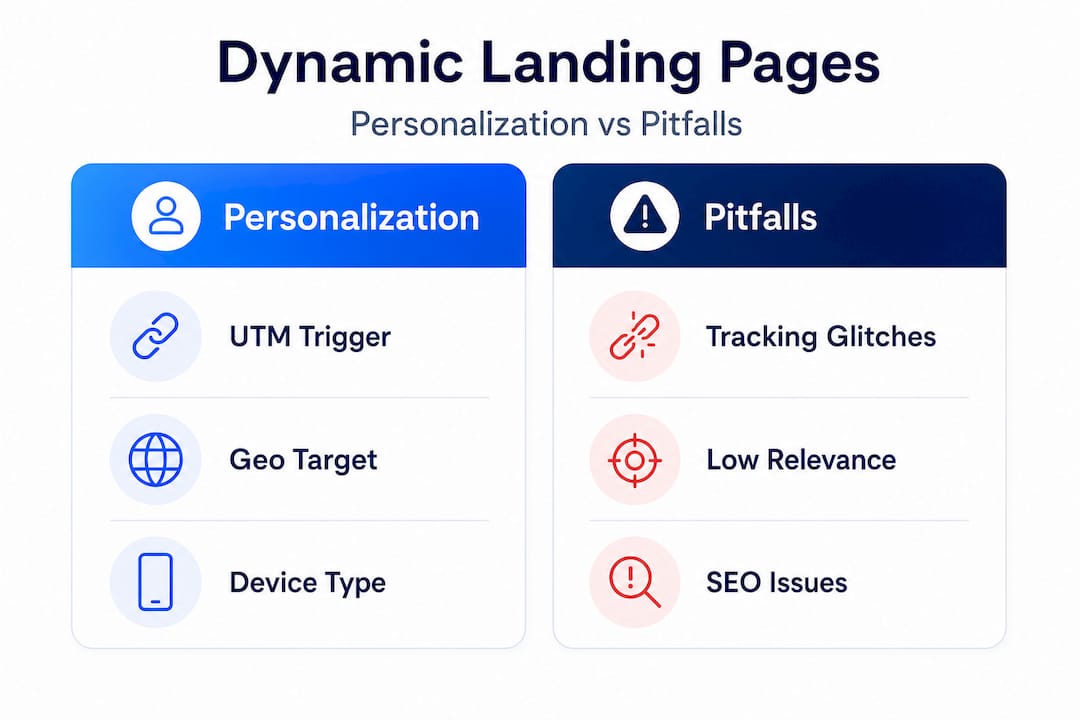
UTM parameters are the most common and accessible trigger. When a visitor arrives via "?utm_source=google&utm_campaign=free-trial`, your page can read those values and swap in a headline that mirrors the ad copy. This message match between ad and page is one of the highest-impact personalization moves available.
Geographic location lets you tailor offers by country, state, or city. An insurance platform might show "Get covered in Texas" versus "Get covered in California" based on IP detection. The catch is that IP resolution is only 60-70% accurate, so geo-based personalization should enhance messaging, not gate content behind it.
Device type is underused but powerful. Mobile visitors convert differently than desktop visitors. They scroll faster, read less, and tap buttons instead of clicking them. A dynamic page that loads a stripped-down mobile variant with a click-to-call CTA will outperform a responsive page that just shrinks the desktop layout.

CRM signals represent the most sophisticated tier. If you're running paid retargeting to your existing subscriber list, your CRM can pass attributes like subscription tier, industry, or engagement history to the page. A churned customer sees a win-back offer. A free-plan user sees an upgrade message.
| Trigger type | What it reads | What to personalize |
|---|---|---|
| UTM parameter | Campaign, source, medium | Headline, CTA, offer block |
| Geographic location | Country, state, city | Pricing, regional offers, imagery |
| Device type | Mobile, tablet, desktop | Layout, CTA format, image size |
| CRM data | Tier, industry, lifecycle stage | Testimonials, messaging tone, offer |
| Referral URL | Landing source domain | Brand mention, trust signals |
Pro Tip: Before you turn on any dynamic rules, audit your UTM naming conventions. Inconsistent UTMs like "Google" vs. "google" vs. "Google_Search" create gaps in your trigger logic and silently serve the default content to a big portion of your traffic. Standardize first, then personalize. Pairing this with personalization techniques for speed ensures your dynamic content loads without sacrificing page performance.
Pitfalls and technical edge cases: When does dynamic fail?
Understanding the mechanics behind dynamic personalization makes it clear how much can go right, but also reveals risks if things go wrong. Dynamic pages are more complex than static ones by nature. More moving parts mean more failure modes.
Here's a direct comparison of solid versus risky personalization strategies:
| Strategy | Solid approach | Risky approach |
|---|---|---|
| Keyword insertion | Match headline to primary keyword | Stuff 4-5 keywords into one headline |
| Geo targeting | Adjust offer language by region | Gate entirely different content behind IP |
| CRM personalization | Change testimonial or CTA | Completely rewrite body copy per segment |
| Mobile optimization | Simplify layout and CTA for mobile | Show an entirely different page design |
| Thin content variants | All variants share a strong base page | Create near-duplicate pages with minimal difference |
Common failure points include tracking glitches from poorly structured UTMs, irrelevant personalization that lowers your ad Quality Score, IP resolution accuracy sitting around 60-70%, over-personalization creating a maintenance burden, and thin or keyword-stuffed variants earning Google penalties.
The Quality Score issue is especially important for paid search marketers. Google's Quality Score rewards relevance between your ad, keyword, and landing page. If your dynamic rule misfires and shows an irrelevant headline, your score drops and your cost-per-click rises. You've paid for the click and made it more expensive.
Before deploying dynamic content, run through this checklist:
- Confirm your UTM parameters are consistent and standardized across all campaigns.
- Test every dynamic rule in a staging environment before pushing to production.
- Set a strong default content fallback for visitors who don't match any rule.
- Verify that your analytics tool is correctly attributing conversions per variant.
- Check that all content variants meet your minimum word count to avoid thin content flags.
- Review each variant for brand voice and logical flow, not just keyword match.
Pro Tip: Protect your SEO by ensuring that search engines index only your canonical page, not individual dynamic variants. Use a single canonical URL and avoid creating URL parameters that generate crawlable duplicate pages. Avoiding over-personalization is as important as implementing it thoughtfully.
Best practices for A/B testing dynamic landing pages
Avoiding technical and strategic pitfalls lets you unlock the real potential of dynamic landing pages, but only when paired with smart, structured A/B testing. Dynamic personalization tells you what content each visitor sees. A/B testing tells you which version actually converts better. You need both working together.
Here's a step-by-step process for setting up effective tests on dynamic pages:
- Identify your highest-traffic trigger segment first. If 40% of your traffic comes from one Google campaign, start your test there. You'll reach statistical significance faster.
- Isolate one variable per test. Testing a headline and a CTA button simultaneously muddies the results. Change one element, measure the impact, then move to the next.
- Set your success metric before you launch. Is it form submissions? Scroll depth? Button clicks? Define it upfront so you're not cherry-picking results after the fact.
- Run tests long enough to remove day-of-week bias. A test that only runs Tuesday through Friday will miss weekend traffic behavior. Aim for at least two full calendar weeks minimum.
- Use a 50/50 split to start. Unless one variant poses real conversion risk, split traffic evenly between control and variant for the cleanest comparison.
When it comes to which A/B testing strategies to prioritize, dynamic headlines are consistently the highest-impact element to test first. A headline change affects every visitor who lands on the page. A button color change doesn't. Rank your tests by expected impact multiplied by the percentage of visitors who will actually see that element.
The elements worth testing on dynamic pages, in rough priority order:
- Primary headline (highest reach, highest impact)
- CTA button text (low friction to test, measurable click data)
- Hero image or video (device-specific variants perform very differently)
- Social proof placement (above vs. below the fold matters more than most think)
- Form length or lead capture format (fewer fields almost always wins, but test it)
For a faster path to results, the 15-minute landing page optimization guide is worth bookmarking as a companion to your testing process.
Pro Tip: Don't pause a test the moment you see a "winning" variant at 80% confidence. Wait for 95% statistical significance before calling it. Premature winners are one of the most common reasons marketers implement changes that don't actually hold up over time. Patience in testing pays off in conversion rates that actually stick.
A marketer's take: What most people get wrong about dynamic landing pages
The best practices for A/B testing bring us to a bigger-picture lesson: dynamic landing pages are only as powerful as the strategy behind them.
Here's the uncomfortable truth. Most marketers who invest in dynamic personalization spend 80% of their time on the technology setup and 20% on the actual strategy. They configure triggers, build rules, install scripts, and then wonder why their conversion rates barely moved. The tooling isn't the bottleneck. The thinking is.
The assumption that more personalization equals more conversions is seductive but often wrong. We've seen campaigns where a single, well-crafted dynamic headline swap, matching the ad keyword to the page headline, outperformed elaborate multi-segment personalization trees that took weeks to build. The simple version was easier to maintain, faster to test, and more reliable.
There's also a subtler problem: over-personalization can feel creepy. When a landing page mirrors too precisely what a visitor was just searching for, it can trigger a "how did they know?" reaction that erodes trust rather than building it. Personalization should feel helpful, not surveillance-adjacent. The goal is relevance, not omniscience.
The marketers who get the most out of dynamic pages treat them as a hypothesis engine, not a set-it-and-forget-it system. They start with a clear guess: "Visitors from this campaign care more about speed than price." They build one dynamic rule to test that hypothesis. They measure. They learn. Then they expand. That cadence of test, learn, and iterate is exactly what advanced landing page copywriting principles reinforce. Great copy and smart personalization go together.
Simplicity and consistency beat complexity and novelty in most campaigns. The brands that scale conversion rates aren't the ones running 47 dynamic variants. They're the ones who found two or three signals that genuinely predict visitor intent and personalized around those with discipline.
How to put dynamic landing pages to work for you
Once you know how to avoid common pitfalls and where to focus your energy, choosing the right tools can make dynamic landing pages a scalable reality for your campaigns.
Stellar makes this accessible for exactly the type of marketer reading this article. You don't need a developer. You don't need a six-week implementation project.
The GoStellar platform is built for SMB marketers who want to move fast. Its no-code visual editor lets you build and test dynamic landing page variants without writing a single line of code. The dynamic keyword insertion feature handles the UTM-to-headline personalization that's the single highest-impact starting point for most campaigns. At just 5.4KB, the script adds almost no load time, which protects your Quality Score and user experience simultaneously. Real-time analytics let you catch a losing variant early and redirect traffic before it drains your budget. If you're under 25,000 monthly tracked users, you can start free and build your testing muscle before investing further.
Frequently asked questions
How does a dynamic landing page improve conversion rates?
Dynamic landing pages boost conversions by showing visitors personalized headlines and CTAs based on their data, creating more relevant and persuasive experiences that reduce the gap between what an ad promises and what the page delivers.
What data do dynamic landing pages use to personalize content?
Common data sources include location, device type, referral URL (UTM), intent signals, and CRM attributes, all of which can trigger real-time content swaps without creating separate pages.
What's the main risk of dynamic landing pages?
The biggest risks are technical glitches and Quality Score drops from poorly matched personalization, as well as potential SEO penalties for thin or near-duplicate content variants.
Can you A/B test elements on a dynamic landing page?
Yes, any dynamic element can be systematically tested just like static components, and combining A/B testing with personalization triggers gives you the clearest signal about what actually drives conversions for each audience segment.
Recommended
Published: 5/8/2026