
Usability Testing Companies: Growth Team Guide
For growth teams chasing fast A/B wins, a self-service experiment platform beats hiring a full-service usability firm most of the time. Hire a firm when you need deep behavioral diagnosis. Use a platform when you need to ship and test inside a sprint.
When to hire a usability testing company:
- Complex flows where you need to know why users fail, not just how many do
- Accessibility audits or cross-market benchmarking requiring expert moderation
- Expert-led studies that start around $40,000 for rigorous behavioral work
When to use a self-service platform instead:
- Validating A/B hypotheses before committing dev resources
- Iterative funnel tweaks tied to a two-week sprint
- Continuous feedback loops that a consultant engagement can't sustain
Quick-start sequence: Run a scoped unmoderated test to surface the top friction point. Extract the one highest-impact fix. Push it into an A/B experiment the same week.
Table of Contents
- What's the difference between moderated and unmoderated usability testing?
- What should you expect from a usability testing company?
- How does participant recruitment affect your results?
- Which metrics actually matter for growth teams?
- How do you evaluate and select usability testing companies?
- Questions to ask usability testing companies before you hire
- Red flags to watch for when choosing a usability testing provider
- How do you fit usability testing into a sprint cadence?
- Gostellar: the experiment-first alternative for growth teams
- Key Takeaways
What's the difference between moderated and unmoderated usability testing?
Moderated sessions put a researcher in the room (or on a call) while a participant thinks out loud. You get the why: the hesitation before a click, the confused re-read of a label. Unmoderated sessions run without a facilitator. Participants complete tasks on their own devices, and you get task success rates and screen recordings at scale.
The practical split: moderated for diagnosing root causes, unmoderated for measuring how widespread a problem is. Growth teams typically run unmoderated first, then bring in moderated sessions when a metric won't move and they can't explain it.
What should you expect from a usability testing company?
A serious firm delivers more than a recording dump. Expect prioritized findings ranked by severity, direct user quotes tied to video timestamps, and a debrief session that maps issues to your product roadmap. Expert-led engagements include workshop-ready recommendations, not just raw clips.
Self-service platforms compress this into automated dashboards. Useful for speed, but the synthesis is shallower. If your team can act on a highlight reel, a platform works. If you need someone to tell you what the pattern means across 40 sessions, hire a firm.
How does participant recruitment affect your results?
Panel quality is where most cheap options fall apart. Testlio, for example, vets participants by geography, language, device, and usage behavior before any session begins. Testbirds uses a credit-based crowdtesting model with a large global tester community, giving broad device and locale coverage at lower per-test cost.

Userfeel claims a panel of 7 million testers with human verification and no bots. UserTesting serves 75 of the Fortune 100 and has 20 years of research experience behind its recruitment methodology. The rule: the closer the panel matches your actual users, the fewer sessions you need to reach a confident finding.
Which metrics actually matter for growth teams?
Three numbers move the needle: task success rate, time-on-task, and satisfaction. Task success rate tells you whether users can complete the goal at all. Time-on-task flags friction even when users eventually succeed. Satisfaction scores (CSAT or the System Usability Scale) capture perception, which often predicts churn before your analytics do.
Map each metric directly to a conversion funnel step. A UX metrics framework tied to funnel stages turns usability findings into A/B hypotheses you can test the same sprint.
How do you evaluate and select usability testing companies?
Five criteria separate strong providers from generic ones:
- Domain expertise: Testlio covers finance, healthcare, retail, and media with specialized researchers per vertical.
- Recruitment rigor: Screened, vetted panels beat open-invite communities for signal quality.
- Turnaround SLA: AI-assisted platforms compress findings from weeks to hours; confirm what the firm actually commits to.
- Integrations: Testlio connects to Jira and TestRail so findings land in your backlog without a manual handoff.
- Security: Testlio holds ISO/IEC 27001:2022 certification, which matters for enterprise and regulated products.
UserZoom (now part of UserTesting) targets enterprise UX teams needing large-scale benchmarking. Userfeel suits smaller teams that want continuous testing without an enterprise contract. Testbirds fits high-volume, cross-market QA. Match the provider to the job, not the brand name.
Questions to ask usability testing companies before you hire
Don't sign until you have clear answers to these:
- How do you recruit and screen participants for my specific user profile?
- What does a sample deliverable look like, and who owns the analysis?
- What's the realistic turnaround from kickoff to final report?
- How do findings integrate with our sprint or release cadence?
- What happens if the study scope changes mid-engagement?
The last question is the one most teams skip. Scope creep in a fixed-price engagement can stall delivery by weeks.
Red flags to watch for when choosing a usability testing provider
Generic panels are the biggest one. If a provider can't describe how they screen participants beyond "we have a large database," your findings will reflect a convenience sample, not your users. Other warning signs: no sample report available before you commit, vague turnaround estimates ("it depends"), and no named researcher or methodology attached to the engagement.
Avoid providers who lead with volume ("we'll get you 200 testers") without explaining how those testers match your audience. Scale without relevance produces noise, not insight.
How do you fit usability testing into a sprint cadence?
Treat research as a recurring sprint input, not a one-off project. The pattern that works: integrate testing into your release cadence so findings arrive before the next sprint planning, not after the feature ships.
A practical cadence for growth teams: run an unmoderated test in week one, extract the top two friction points, build A/B variants in week two, and read results before the next planning session. Moderated sessions fit quarterly, when a metric has stalled and you need root-cause diagnosis before committing to a larger build.
Gostellar: the experiment-first alternative for growth teams
Most usability testing companies are built for research teams. Gostellar is built for marketers who need to move from question to live experiment in a single sprint.
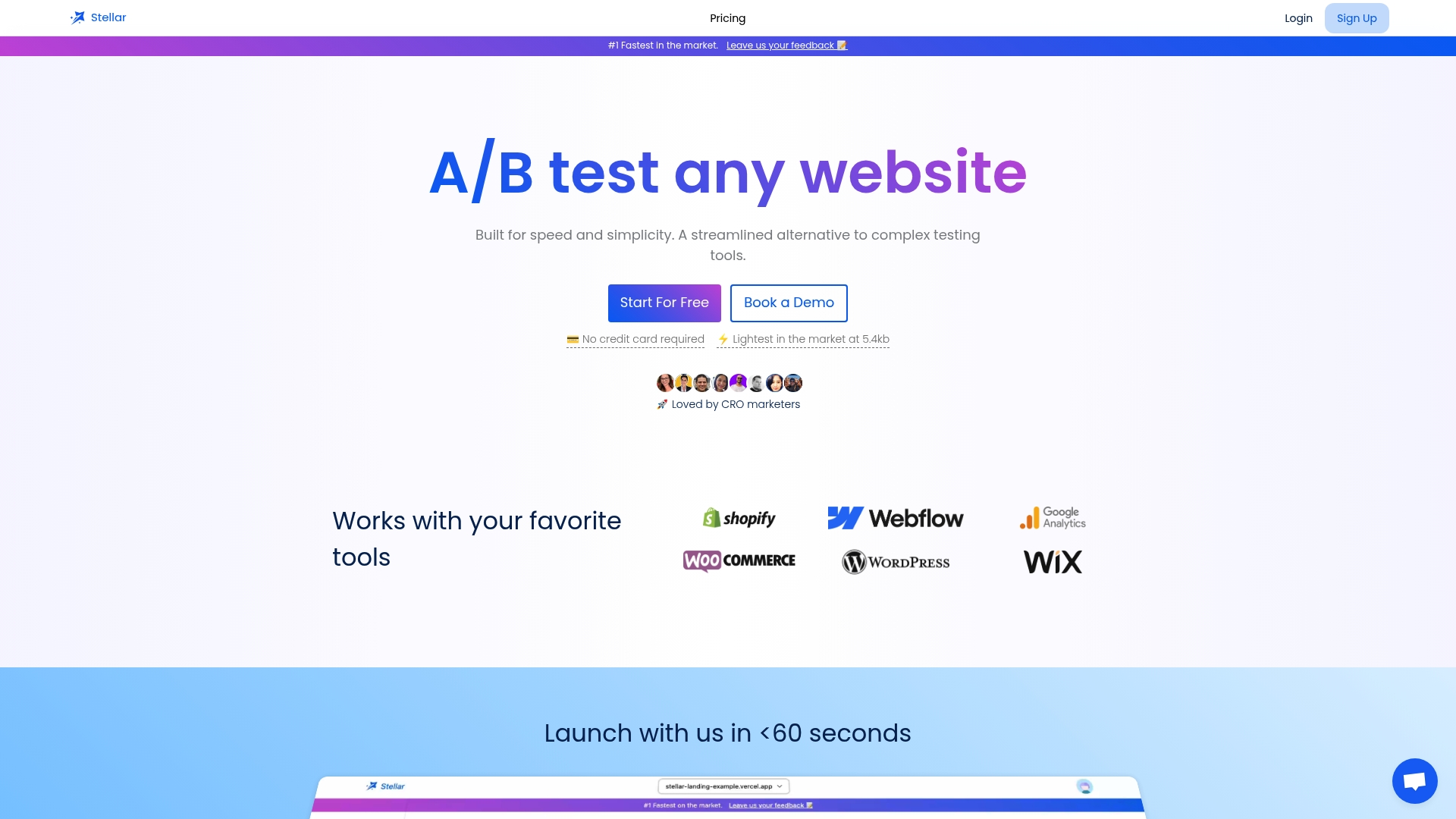
Gostellar's A/B testing platform runs on a 5.4KB script that won't slow your pages, a no-code visual editor that doesn't require a developer, and real-time analytics that surface winning variants as data comes in. Advanced goal tracking connects experiment outcomes directly to conversion metrics, so you're not waiting for a report to know what worked.
When firms still make sense: deep behavioral studies, hard-to-reach segments, and accessibility audits need expert moderation. For everything else, a self-service experiment pipeline gets you answers faster and at a fraction of the cost.
Get started the same day: define your hypothesis, install the Gostellar script, set your conversion goal, split your traffic, and read results in real time. Start your free trial and run your first experiment before the week is out.
Usability testing provider comparison
| Provider | Best for | Moderated / Unmoderated | Recruitment | Turnaround | Pricing model | Integrations | Reporting |
|---|---|---|---|---|---|---|---|
| Stellar (Gostellar) | Rapid A/B experiments, growth teams | Unmoderated (experiment-driven) | Self-serve traffic split | Real-time | Subscription tiers; free plan available | Analytics, experiment pipelines | Real-time dashboard, goal tracking |
| Enterprise research firms | Deep behavioral diagnosis, benchmarking | Both; expert-moderated | Bespoke, custom screeners | Weeks | Per-study; often $40,000+ | Varies | Prioritized reports, workshops |
| Self-service usability platforms | Continuous feedback, sprint-aligned testing | Both | Panel-based, automated | Hours to days | Subscription or per-minute | Analytics, PM tools | Automated summaries, dashboards |
| Crowdtesting and specialist panels | High-volume, cross-market, device coverage | Unmoderated primarily | Large crowd pools, locale filters | Days | Per-test or credit-based | QA tools | Task metrics, video clips |
| UserTesting | Enterprise insight at scale | Both | 20+ year panel; Fortune 100 clients | Days | Subscription (enterprise) | Broad integrations | AI-powered analysis, clips |
| UserZoom | Large-scale UX benchmarking | Both | Enterprise panels | Days to weeks | Subscription (enterprise) | Enterprise tools | Benchmark reports |
| Userfeel | Continuous testing for smaller teams | Unmoderated primarily | 7M+ human-verified testers | Hours to days | Tiered subscription | Limited | AI-assisted analysis |
| Testlio | Managed, full-service usability + QA | Both | Vetted global community; screened by geo, device, language | Days | Platform fee + consumption fund | Jira, TestRail | Prioritized findings, severity ranking |
| Testbirds | Cross-market crowdtesting, quantitative UX | Both | Large global crowd; BirdCoin credit model | Days | Credit-based | Condens | Video clips, quantitative metrics |
Key Takeaways
For growth teams, self-service experiment platforms cover most usability needs faster and cheaper than full-service firms; hire a firm only when you need expert-moderated behavioral diagnosis or cross-market benchmarking.
| Point | Details |
|---|---|
| Hire vs. platform rule | Use a firm for deep behavioral diagnosis; use a platform for sprint-aligned A/B experiments. |
| Expert study cost | NN/g-style expert-led engagements often start around $40,000 for rigorous behavioral work. |
| Panel quality matters | Screened, vetted panels matched by geography, device, and behavior produce more reliable findings than open-invite databases. |
| Sprint-aligned cadence | Run unmoderated tests in week one, build A/B variants in week two, read results before the next sprint planning session. |
| Gostellar for growth teams | Gostellar's 5.4KB script, no-code editor, and real-time analytics let growth teams run experiments without a developer or a research budget. |
Recommended
Published: 7/27/2026