
User experience design: a marketer's guide to better results
TL;DR:
- User experience design shapes all user interactions, not just visuals or aesthetics.
- Ongoing UX practices, including testing and research, generate long-term marketing improvements.
- Combining usability testing with A/B experiments maximizes conversion and enhances customer experience.
User experience design is not about making things pretty. That's the misconception that quietly costs businesses conversion rates, campaign performance, and testing accuracy every single day. If you're a marketer or product manager at a small to medium-sized business, you've probably heard "UX" thrown around in design meetings and assumed it belonged in someone else's lane. It doesn't. Understanding UX design is one of the sharpest tools you can add to your A/B testing strategy, and this guide will show you exactly how to use it, step by step, without needing a design degree.
Table of Contents
- User experience design explained
- The user experience design process
- Why usability matters for marketers
- Applying UX design to A/B testing
- A fresh perspective on UX design for marketers
- Take your UX testing further
- Frequently asked questions
Key Takeaways
| Point | Details |
|---|---|
| UX is holistic | User experience design covers every part of how people interact with your product, not just visuals. |
| UX follows a process | Empathizing, defining, prototyping, and testing are key steps marketers can use to solve user problems. |
| Usability boosts results | Improving usability through testing leads to higher conversions and more effective campaigns. |
| Test with users | A/B testing combined with UX principles helps uncover what really works for your audience. |
User experience design explained
Let's clear something up right away. User experience design is not visual design. It's not just about picking font colors or making a button look prettier. UX design is the discipline of shaping every interaction a person has with your product or service, from the moment they land on your site to the moment they leave, and everything in between.
The most useful definition comes from usability researchers who studied this for decades. As usability.gov explains, UX design is about creating products that are useful, usable, accessible, credible, desirable, findable, and valuable, focusing on user interactions beyond just visuals. That's seven distinct dimensions, not one. Each one represents a different way your product can either serve your users or let them down.
Here's what each of those dimensions actually means in plain terms:
- Useful: Does the product help users accomplish something real?
- Usable: Can they do it without confusion or frustration?
- Accessible: Can people with varying abilities use it effectively?
- Credible: Does the product feel trustworthy?
- Desirable: Do users actually want to engage with it?
- Findable: Can users locate what they need quickly?
- Valuable: Does it deliver enough value to keep them coming back?
"User experience encompasses all aspects of the end-user's interaction with the company, its services, and its products." This means every touchpoint, not just the screen design.
For marketers, this framework is genuinely useful. When you run a campaign or build a landing page, you're making decisions that touch all seven of these dimensions without realizing it. Your headline affects credibility. Your call-to-action placement affects usability. Your page load speed affects desirability. Once you see UX this way, your user experience optimization guide becomes less of a design document and more of a marketing playbook.
The practical implication here is significant. A/B tests that only tweak visual elements, like button colors or image choices, are working on one of the seven UX dimensions at best. Marketers who understand the full picture can run richer, smarter experiments that address multiple dimensions at once and produce more meaningful results.
The user experience design process
Once you know what UX is, it's crucial to understand how it's put into practice. The most widely adopted framework is design thinking, a structured process that moves from research to real-world testing in repeatable cycles.
Core UX methodologies follow the design thinking model: Empathize, Define, Ideate, Prototype, Test, and Iterate. Each phase has a distinct purpose, and together they form a loop, not a straight line. That loop matters because it means UX is never "done."
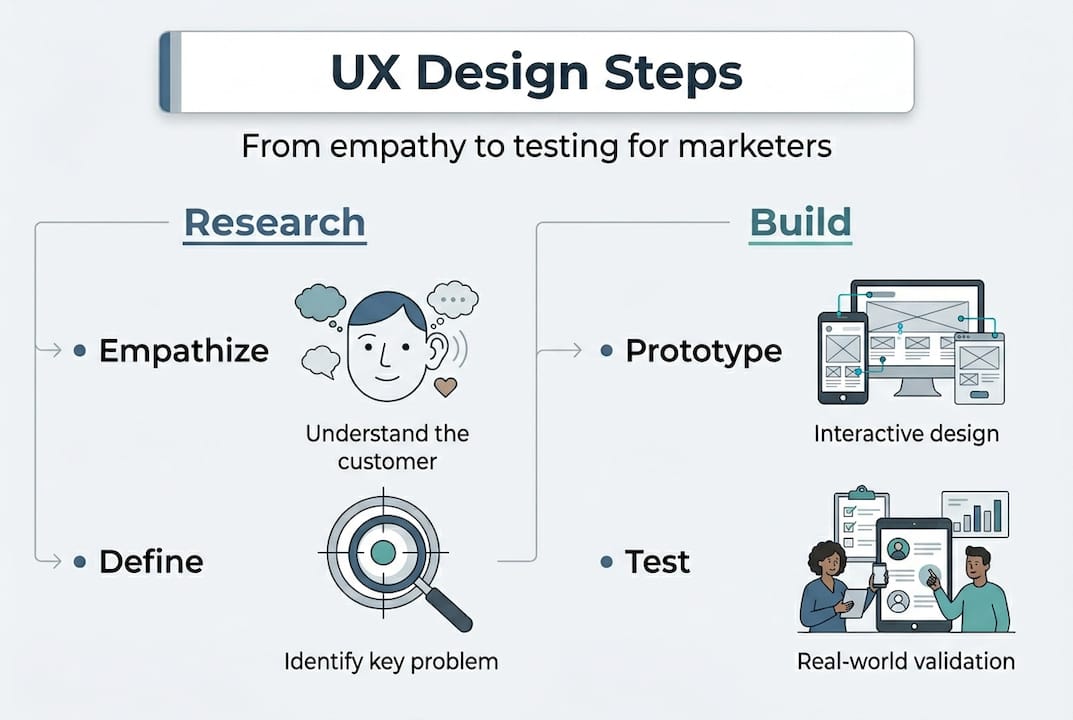
Here's how those phases map to real tasks:
| Phase | What it involves | Marketing example |
|---|---|---|
| Empathize | User interviews, surveys, heatmaps | Discovering why visitors leave checkout |
| Define | Synthesizing findings into problem statements | "Users can't find the pricing information they need" |
| Ideate | Brainstorming solutions without judgment | Listing ten possible ways to restructure the pricing page |
| Prototype | Building low-fidelity mockups or drafts | Creating two versions of a landing page layout |
| Test | Usability testing and A/B experiments | Running tests with real visitors to measure performance |
| Iterate | Applying insights and repeating the cycle | Updating the winning version and testing the next variable |
For a marketer or product manager, following this process is surprisingly accessible. You don't need a design team to start. Here's a simplified approach:
- Gather user signals: Use heatmaps, session recordings, and customer surveys to understand what your users are actually doing on your site.
- Write a problem statement: Be specific. "Our signup form loses 60% of users before completion" is actionable. "UX is bad" is not.
- Generate variations: Brainstorm at least three distinct approaches to solving the identified problem. Involve your whole team, including support and sales.
- Build testable versions: Use a no-code editor to create page variations without touching your codebase, keeping your team moving fast.
- Run structured tests: Measure performance using clear metrics, like conversion rate, time on page, or task completion rate.
- Use what you learn: Document findings and feed them back into step one. That's the iterate phase, and it's where the real compounding value comes from.
The user journey optimization steps map closely to this process. When you frame your marketing work as a repeating UX cycle rather than a series of one-off campaigns, you build momentum. Each test teaches you something that makes the next test smarter.
Why usability matters for marketers
With the overall process in mind, it's vital to see why usability, one core aspect of UX, directly impacts marketing outcomes. Usability is specifically about how easily users can complete tasks on your product. It measures three things: effectiveness (can users do the task?), efficiency (how quickly?), and satisfaction (did they feel good about it?).
Research confirms that usability measures task success and satisfaction through testing and is a central pillar of UX design. For marketers, that translates directly into conversion rate performance. A landing page where users struggle to find the form, or a checkout flow that requires too many steps, fails on usability even if it looks beautiful.
Here's why usability should be on every marketer's radar:
- It exposes invisible friction: Usability testing reveals the exact point where users give up, which is something analytics alone can't always tell you.
- It increases conversion rates: Removing a single confusing step in a sign-up flow can dramatically lift completions. Usability work routinely uncovers those steps.
- It makes A/B tests more precise: When you know why users are struggling, you can test targeted fixes instead of random changes.
- It reduces wasted ad spend: Traffic you're buying deserves a page that converts. Poor usability means you're paying for visitors you're losing unnecessarily.
- It applies to every channel: Email landing pages, product pages, checkout flows, onboarding sequences, all are subject to usability standards.
Understanding UX usability for marketers means thinking beyond the interface. Usability problems are often structural: navigation that doesn't match how users think, calls to action buried below the fold, or value propositions that take too long to communicate.
The connection between usability and revenue is also well documented. Marketers who prioritize usability testing consistently see improvements in UX and conversion rates because they're solving actual user problems, not just aesthetic ones.
Pro Tip: Most marketers run usability tests and focus on which interface elements users click. That's useful, but the bigger gold mine is understanding the moments of hesitation — when users pause, re-read, or scroll back. Those micro-behaviors reveal the emotional friction that kills conversions. Record your sessions and watch for hesitation, not just action.
Applying UX design to A/B testing
Having established the importance of usability, let's zero in on how UX design and testing intersect with A/B experimentation. A lot of marketers treat A/B testing as a gut-feel exercise: "Let's try a red button instead of blue." UX design gives you the evidence to stop guessing.
A/B testing is a UX tool that compares designs based on task time and success rates, forming a key part of the testing and iteration cycle. It's not separate from UX. It's one of the most powerful methods within it.
Here's how usability testing and A/B testing compare and complement each other:
| Dimension | Usability testing | A/B testing |
|---|---|---|
| Primary objective | Understand why users behave a certain way | Determine which variation performs better |
| Method | Observed task sessions, think-aloud protocols | Live traffic split between two or more versions |
| Sample size | Small (5 to 20 participants) | Large (statistically significant traffic) |
| Timing | Early in the design process | After variations are built and ready to deploy |
| Output | Qualitative insights and problem identification | Quantitative results and conversion metrics |
| Best for | Identifying friction and confusion | Confirming which solution wins at scale |
The smartest testing programs use both. Usability testing tells you what to test. A/B testing tells you what won. Skip the first step, and you're testing hunches. Skip the second, and you're never sure your solution actually scaled.
For practical A/B testing for UX, here are best practices to apply immediately:
- Root every test in user research: If you can't trace your test hypothesis back to a user insight (a heatmap, a support ticket, a session recording), reconsider whether you're testing the right thing.
- Test one variable at a time: Changing the headline, image, and CTA simultaneously makes it impossible to know what drove the result.
- Set your success metric before you start: Decide what winning looks like before the data comes in to avoid confirmation bias.
- Let tests run to statistical significance: Ending early because a variation looks promising is a fast way to make bad decisions.
- Document and share results: Insights from one test should inform the next. Build a shared record your team can reference.
The process of validating A/B testing ideas with user research upfront dramatically improves the quality of your experiments. It shifts your team from reactive tweaking to systematic optimization.
Pro Tip: Before launching any A/B test, write a one-sentence hypothesis using this format: "We believe that [change] will [outcome] because [user insight]." If you can't fill in the "because," you don't yet have enough user data to justify the test. Go back and do the research first.
A fresh perspective on UX design for marketers
Here's the reality check most businesses need: UX design gets treated like a renovation project. You bring in a designer, they overhaul the site, and everyone moves on. That's not a UX strategy. That's a one-time expense with no compounding return.
The marketers and product teams who see the biggest long-term wins from UX are the ones who treat it as an ongoing practice, not a deliverable. They're constantly collecting growth marketer UX tips from real user behavior, feeding those signals into their next tests, and updating their assumptions based on what they learn.
The uncomfortable truth is that most UX problems aren't design problems. They're communication problems, structural problems, or positioning problems, all things that fall squarely in the marketer's domain. When you stop outsourcing UX thinking and start applying it yourself, every campaign you run gets sharper. Stop limiting UX to one team or one sprint. Let it inform every customer-facing decision you make, from email subject lines to onboarding flows to pricing page copy. That's where the real leverage is.
Take your UX testing further
When you're ready to take the next step in UX-driven marketing, having the right tools makes all the difference. Understanding UX principles is powerful, but applying them through fast, structured experiments is where you'll see real business results.
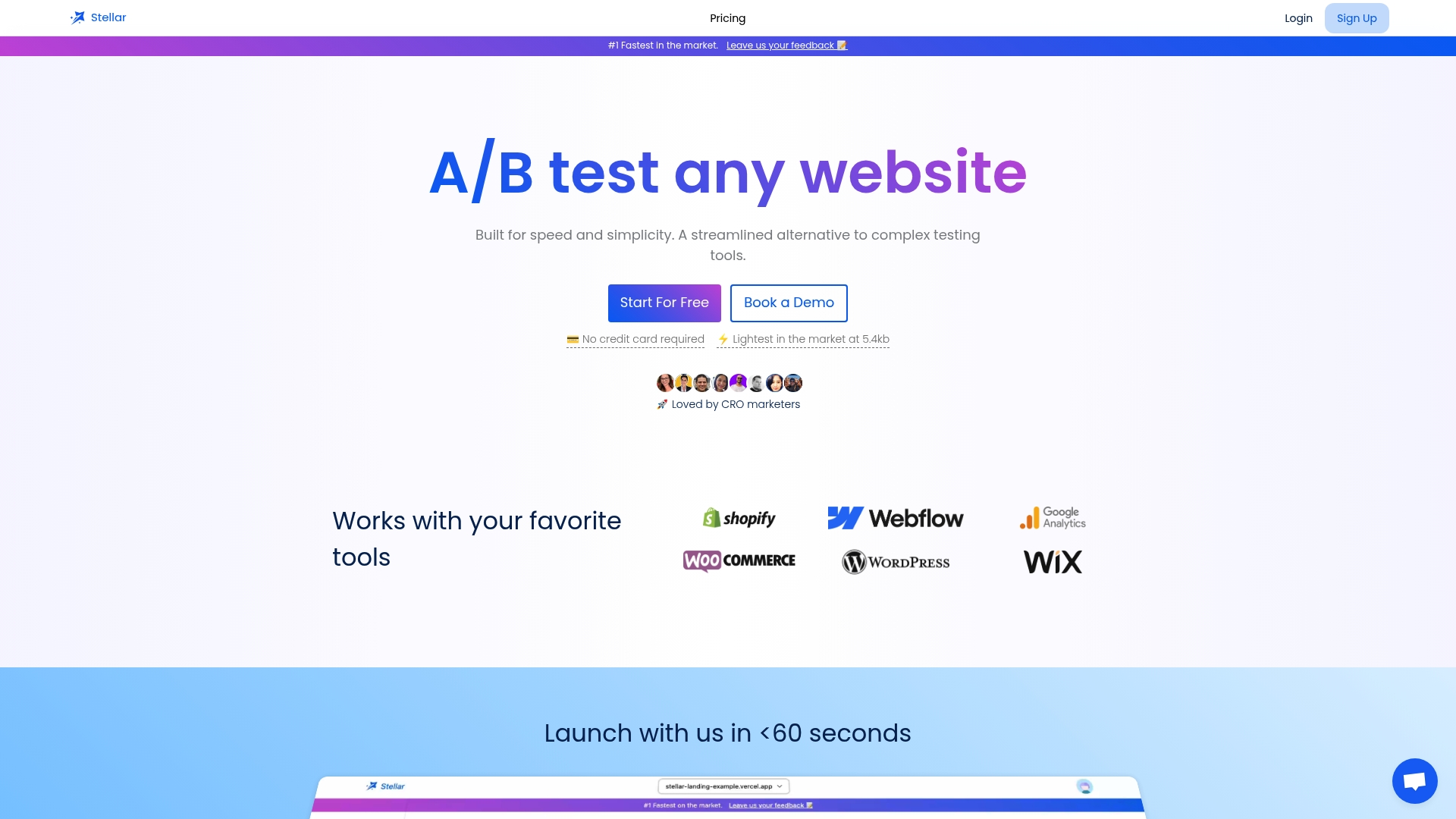
Stellar is built specifically for marketers and product teams at small to medium-sized businesses who want to run smarter A/B tests without the complexity of enterprise tools. With a no-code visual editor, real-time analytics, and a script that weighs only 5.4KB, you can set up and launch experiments quickly without slowing your site down. Whether you're testing landing page layouts informed by usability research or personalizing pages with dynamic keyword insertion, Stellar's A/B testing platform gives you the infrastructure to turn UX insights into measurable wins.
Frequently asked questions
Is user experience design just for designers?
No, UX design is a collaborative process that involves marketers, product managers, and anyone who shapes user interactions, not just design specialists.
How is usability different from user experience?
Usability is a component of UX that focuses on ease and satisfaction in completing specific tasks, while UX covers the entire user journey, including emotions, perceptions, and overall value.
Can A/B testing improve user experience?
Yes, A/B testing helps identify which design or content changes lead to better outcomes, making it a key part of the UX testing cycle and iteration process.
What is an example of applying UX design in marketing?
Collecting user feedback through session recordings, then running A/B tests on landing page layouts to find the version that converts best, is a direct and practical application of UX design thinking in a marketing context.
Published: 4/26/2026