
7 User Experience Optimization Tips for Growth Marketers
Speed can make or break your american website’s success. Studies reveal that even a one-second delay in page load time can decrease user satisfaction by over 15 percent. For today’s growth marketers, getting visitors to stay and engage starts with fast performance and smooth user experience. This guide reveals proven techniques that help american site owners increase user engagement, lower bounce rates, and build a more loyal audience.
Table of Contents
- Prioritize Fast Page Load Times For Better Engagement
- Use A Lightweight Script To Minimize Performance Impact
- Leverage No-Code Tools For Easy A/B Test Implementation
- Apply Dynamic Keyword Insertion For Personalized Ux
- Focus On Clear, Simple Navigation To Reduce Drop-Offs
- Track Goals And User Actions With Real-Time Analytics
- Continuously Iterate Based On User Feedback And Data
Quick Summary
| Key Insight | Explanation |
|---|---|
| 1. Optimize Page Load Speed | Aim for page load times under 3 seconds to reduce bounce rates and improve user engagement. |
| 2. Use Lightweight Scripts | Implement lightweight scripts to enhance performance, reducing load times by up to 40%. |
| 3. Utilize No-Code A/B Testing Tools | Empower marketers to run experiments without coding, facilitating data-driven optimizations quickly. |
| 4. Implement Dynamic Keyword Insertion | Personalize user experiences using real-time keyword adaptation to align with individual search intent. |
| 5. Streamline Navigation Structure | Design intuitive navigation to minimize drop-offs and help users easily find information. |
1. Prioritize Fast Page Load Times for Better Engagement
Speed is the silent conversion killer that most growth marketers overlook. Your website has mere seconds to capture user attention before potential customers bounce away.
Research from GeeksforGeeks highlights that optimizing page speed through strategic techniques can dramatically reduce bounce rates and enhance user engagement. By implementing targeted optimization strategies, you transform your website from a sluggish experience to a rapid, user-friendly platform.
Key Speed Optimization Techniques:
- Compress images without sacrificing quality
- Minimize HTTP requests
- Leverage browser caching mechanisms
- Use content delivery networks (CDNs)
Interestingly, Stanford University suggests that moderate speed animations during loading times can actually improve user experience. This counterintuitive insight means you do not always need to strip everything away but can design intelligent loading experiences.
Implementing these strategies requires a systematic approach. Start by auditing your current page load times using tools like Google PageSpeed Insights. Identify bottlenecks and prioritize fixes that deliver the most significant performance improvements. Remember that every millisecond counts when keeping potential customers engaged and preventing them from clicking away.
Pro tip: Aim for load times under 3 seconds across mobile and desktop platforms. Websites loading faster than this benchmark see substantial increases in conversion rates and user satisfaction.
2. Use a Lightweight Script to Minimize Performance Impact
Every byte of code your website loads impacts user experience and conversion potential. Lightweight scripts are the secret weapon for growth marketers seeking to optimize website performance without compromising functionality.
Research from American Academic Scientific Research Journal reveals that implementing smart script strategies like lazy loading and code splitting can reduce page load times by up to 40%. This dramatic improvement directly translates to better user engagement and higher conversion rates.
Performance Optimization Strategies:
- Implement code splitting techniques
- Use lazy loading for non critical resources
- Minify JavaScript and CSS files
- Remove unnecessary third party scripts
UCLA research introduces an innovative approach with WebGaze. This system demonstrates how lightweight scripts can intelligently prioritize loading visually important content based on user interaction patterns. The result? A faster perceived loading experience that keeps users engaged.
To implement these strategies effectively, start by conducting a thorough script audit. Identify and eliminate redundant code. Choose scripts with minimal footprints that deliver maximum functionality. Tools like Chrome Developer Tools can help you analyze script performance and identify optimization opportunities.
Remember the goal: create a lean performance environment where every script serves a critical purpose. Your users will thank you with increased engagement and improved conversion rates.
3. Leverage No-Code Tools for Easy A/B Test Implementation
Growth marketers no longer need advanced coding skills to run sophisticated website experiments. No-code A/B testing tools have revolutionized how teams optimize digital experiences with minimal technical overhead.
edX courses highlight the growing importance of accessible experimentation platforms that empower marketers to make data driven decisions without deep technical expertise. These tools democratize website optimization by providing intuitive interfaces for creating and managing tests.
Key No-Code A/B Testing Strategies:
- Select user-friendly visual editors
- Use drag and drop experiment builders
- Implement quick variation creation
- Integrate simple performance tracking
Western Carolina University's research guide emphasizes the importance of selecting tools that provide comprehensive performance insights. The goal is not just creating tests but understanding their impact on user experience and conversion rates.
To get started, identify no-code platforms with robust visual editors and straightforward reporting. Look for solutions that allow you to modify page elements quickly without writing complex scripts. Prioritize tools offering real time analytics and clear statistical significance indicators.
Remember that effective A/B testing is about continuous learning. No-code tools enable faster iterations and more frequent experiments transforming your growth strategy from guesswork to strategic optimization.
4. Apply Dynamic Keyword Insertion for Personalized UX
Customer attention is the most valuable digital currency. Dynamic keyword insertion transforms generic web experiences into personalized journeys that speak directly to individual user intent.
Research from the Weave Journal demonstrates how dynamic content can dramatically improve user engagement by aligning web experiences with specific user expectations. This technique goes beyond simple personalization by creating contextually relevant interactions.
Dynamic Keyword Insertion Strategies:
- Analyze user search intent
- Map keywords to specific audience segments
- Create flexible content templates
- Implement real time content adaptation
Stanford Graduate School of Business suggests that personalized experiences can enhance engagement by meeting user expectations more effectively. This means understanding and anticipating user needs before they explicitly articulate them.
To implement dynamic keyword insertion successfully, start by building comprehensive user personas. Develop a robust keyword mapping strategy that connects user search queries with relevant content variations. Use advanced analytics to track which keyword insertions generate the highest engagement and conversion rates.
Remember that effective personalization is about creating genuine connections. The goal is not just to match keywords but to demonstrate that you understand your users unique needs and challenges.
5. Focus on Clear, Simple Navigation to Reduce Drop-offs
Users decide within seconds whether to explore your website or abandon it. Your navigation structure is the critical roadmap that determines whether visitors stay or leave.
University of Texas at Austin research emphasizes the profound impact of intuitive navigation on site performance. Complex menus and confusing pathways create immediate user frustration that leads to higher bounce rates.
Key Navigation Design Principles:
- Limit main menu items to 5 or 6
- Use clear descriptive labels
- Implement logical hierarchical structures
- Create consistent navigation across pages
- Prioritize mobile responsive design
According to DN.org, streamlined navigation works synergistically with page performance to enhance overall user engagement. This means your navigation strategy should be both visually clean and functionally efficient.
To optimize your navigation, conduct user testing and analyze click through patterns. Use heat mapping tools to understand how visitors interact with your menu. Simplify complex navigation paths and remove unnecessary steps that might confuse or overwhelm users.
Remember that great navigation feels invisible. When users can find exactly what they want without thinking about how they got there you have created a truly exceptional user experience.
6. Track Goals and User Actions with Real-Time Analytics
Growth marketers need more than intuition. Real time analytics transform guesswork into precise strategic decisions by revealing exactly how users interact with your digital experiences.
Simple Solutionz research highlights the critical role of real time tracking in monitoring user actions and optimizing website performance. Understanding user behavior goes beyond simple metrics it is about uncovering actionable insights that drive meaningful improvements.
Key Real-Time Analytics Strategies:
- Set clear conversion goals
- Create custom event tracking
- Monitor user flow and drop off points
- Analyze user interaction patterns
- Implement segmentation for deeper insights
MollyProject.org emphasizes how tracking user behavior can inform targeted strategies to enhance overall digital experience. The most successful growth marketers view analytics not as reports but as living documents that continuously guide optimization efforts.
To maximize real time analytics effectiveness, establish a comprehensive tracking framework. Map out critical user journeys identify key performance indicators and create custom dashboards that provide immediate visibility into user interactions. Use tools that offer granular segmentation and allow you to drill down into specific user behaviors.
Remember that effective analytics are about asking the right questions. Your data tells a story you just need to learn how to read it.
7. Continuously Iterate Based on User Feedback and Data
Successful growth marketing is not about perfect initial strategies but about relentless refinement. Your website is a living organism that demands constant evolution through intelligent data driven insights.
Stanford University research emphasizes the profound importance of continuously adapting website features based on user feedback. Static experiences become obsolete quickly while dynamic approaches create sustained engagement.
Effective Iteration Strategies:
- Collect qualitative and quantitative user feedback
- Implement regular user experience surveys
- Monitor key performance indicators consistently
- Create controlled experiment environments
- Develop rapid testing and implementation cycles
Stanford Graduate School of Business advocates for ongoing adjustments to digital strategies informed by actual user interactions. This means moving beyond vanity metrics to understand genuine user experience signals.
To transform data into meaningful improvements establish a systematic feedback loop. Use tools that capture user interactions implement A/B testing frameworks and create mechanisms for quick implementation of validated insights. Treat each piece of user feedback as a potential breakthrough for optimization.
Remember that iteration is not about making massive changes but making intelligent microscopic adjustments that compound into significant user experience enhancements.
Below is a comprehensive table summarizing the strategies and techniques for enhancing website performance and user experience as discussed throughout the article.
| Strategy | Implementation | Expected Results |
|---|---|---|
| Fast Page Load Times | Compress images, minimize HTTP requests, leverage caching, use CDNs | Reduced bounce rates, higher engagement |
| Lightweight Scripts | Code splitting, lazy loading, minify files | Reduced load times, improved conversions |
| No-Code A/B Testing | Use visual editors, drag-and-drop builders | Data-driven optimization, increased conversions |
| Dynamic Keyword Insertion | Analyze search intent, use content templates | Enhanced personalization, improved user engagement |
| Clear Navigation | Limit menu items, use descriptive labels, ensure consistency | Reduced drop-offs, better user experience |
| Real-Time Analytics | Set goals, monitor user flow, segment insights | Precise strategy adjustments, increased engagement |
| Continuous Iteration | Collect feedback, conduct surveys, create experiments | Sustained engagement, improved user experience |
Unlock Seamless User Experience Optimization with Stellar
Growth marketers face the constant challenge of balancing fast, engaging web experiences with effective experimentation and personalization. This article highlights crucial pain points like slow page load times, heavy scripts, and complex A/B testing setups that often prevent you from delivering smooth, tailored experiences. Stellar directly addresses these challenges with its lightning-fast, 5.4KB lightweight script designed to minimize performance impact while boosting user engagement.
With features such as a no-code visual editor, dynamic keyword insertion, and advanced goal tracking, Stellar empowers marketers and growth hackers to implement A/B tests quickly and personalize content effortlessly. Imagine having real-time analytics to guide continuous iteration without requiring technical resources. This not only reduces bounce rates but also transforms data-driven decisions into growth opportunities.
Ready to elevate your user experience and conversion rates now?
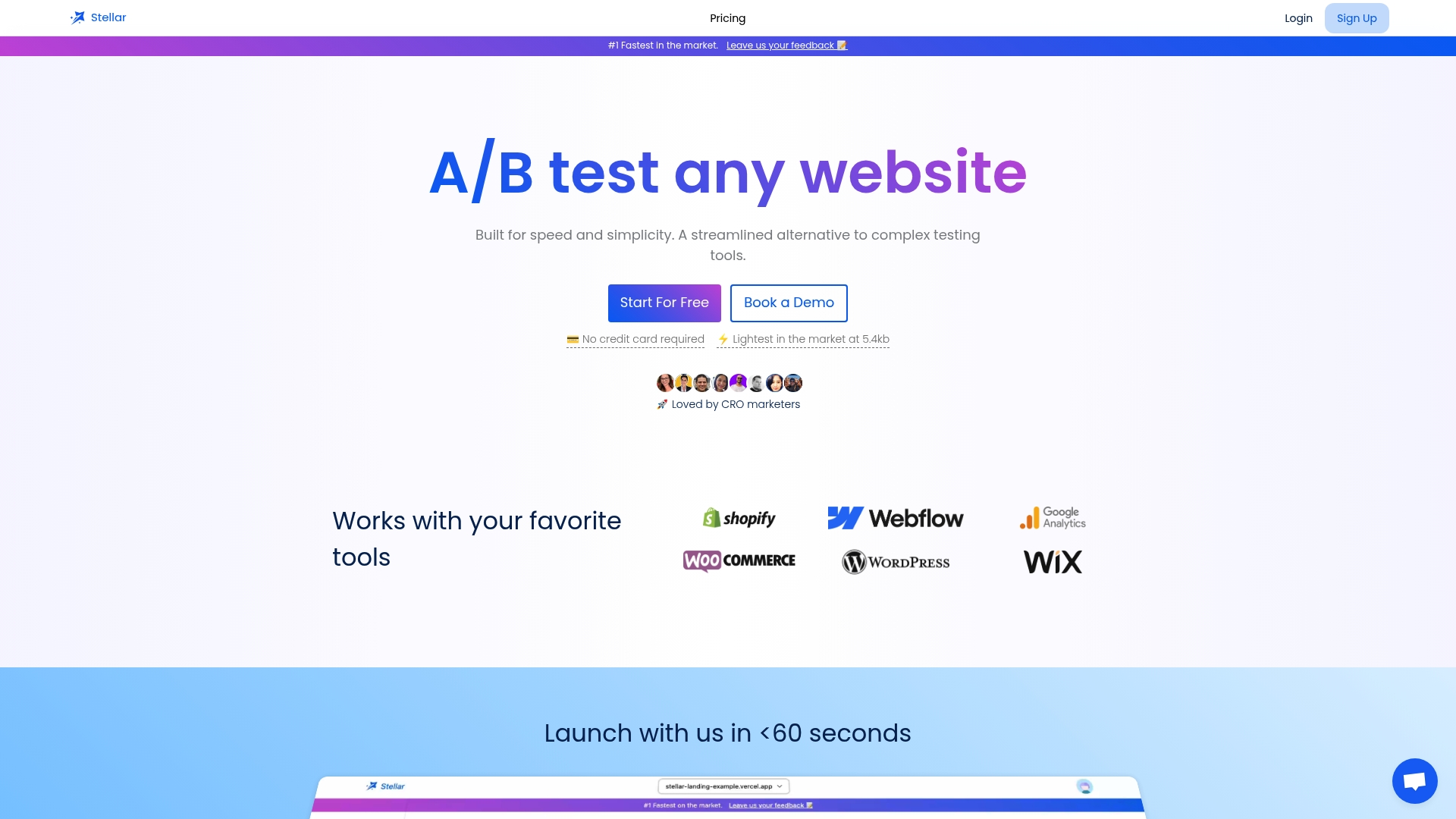
Discover how Stellar’s powerful yet simple platform can streamline your marketing efforts. Start optimizing your digital experience today by visiting Stellar and explore the ease of setup with our Visual Editor. See how dynamic content works by harnessing Dynamic Keyword Insertion and watch your website performance soar.
Frequently Asked Questions
How can I optimize my website for faster page load times?
To improve your website's load speed, focus on compressing images, minimizing HTTP requests, and leveraging browser caching. Start by conducting an audit of your current load times and implement changes that can reduce load times to under 3 seconds.
What are some lightweight script strategies I should use to enhance performance?
Utilize techniques like code splitting and lazy loading to minimize the impact of scripts on your website's performance. Aim to remove unnecessary scripts and minify JavaScript and CSS files to improve user engagement and reduce load times by approximately 40%.
How do I implement A/B testing without coding skills?
You can use no-code A/B testing tools that offer visual editors and drag-and-drop functionalities to create experiments easily. Prioritize tools that provide intuitive interfaces and real-time analytics to streamline your testing process.
What is dynamic keyword insertion and how can it benefit user experience?
Dynamic keyword insertion allows you to tailor content based on user search intent, creating a more personalized web experience. Map keywords to specific audience segments and implement real-time content adaptation to significantly enhance user engagement.
How can I simplify my website’s navigation to reduce bounce rates?
To create clearer navigation, limit menu items to about five or six, use descriptive labels, and establish a logical structure. Conduct user testing to pinpoint complex paths and streamline navigation to promote a smoother user experience.
What steps should I take to continuously improve based on user feedback?
Establish a systematic feedback loop by collecting both qualitative and quantitative data on user experience. Implement regular surveys and monitor key performance indicators to guide your optimization efforts effectively.
Recommended
- User Experience Optimization: Complete Guide for Marketers
- How to Increase Conversions: 7 Proven Strategies for Success
- 7 Essential User Experience Best Practices for Success
- 7 Common Pitfalls in Digital Marketing and How to Avoid Them
- Boosting IG Engagement: 9 Tips for Small Businesses in 2025 - Hexrate
Published: 11/22/2025