
User Journey Optimization for Marketers: Step-by-Step Success
Most American businesses lose nearly 30 percent of potential conversions by failing to track real-time customer interactions. For digital marketers and growth hackers at small or medium-sized companies, maximizing every touchpoint can feel overwhelming without advanced technical know-how. With the right A/B testing strategies, you can uncover hidden friction in your user journey, apply quick fixes, and make sure every engagement counts. Get ready to turn complex analytics into practical wins with less hassle.
Table of Contents
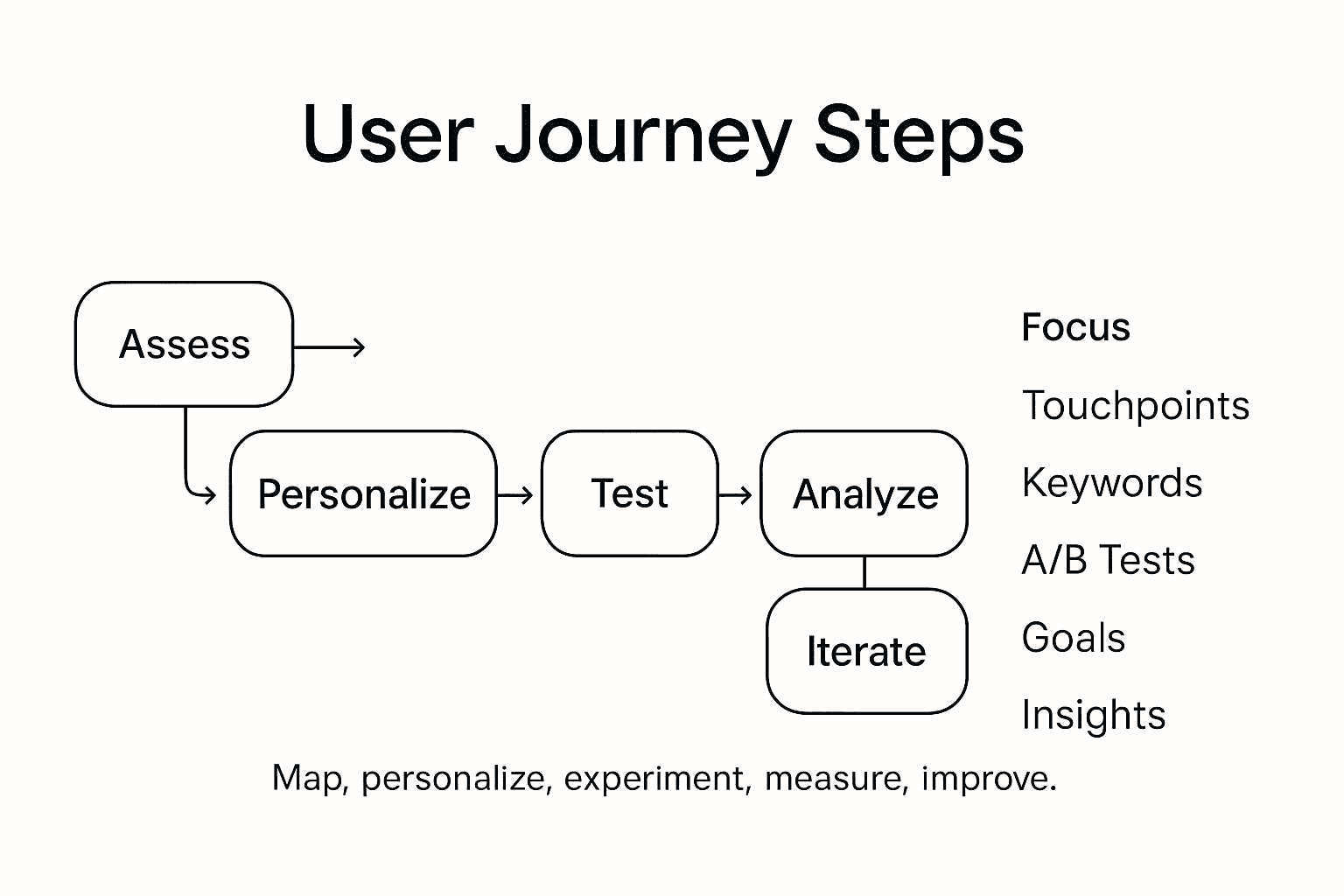
- Step 1: Assess User Touchpoints With Real-Time Analytics
- Step 2: Configure Dynamic Keywords For Personalized Journeys
- Step 3: Set Up Targeted A/B Tests Using A Visual Editor
- Step 4: Track And Analyze Conversion Goals In Detail
- Step 5: Validate And Iterate Based On Actionable Insights
Quick Summary
| Key Insight | Explanation |
|---|---|
| 1. Assess User Touchpoints with Analytics | Map all customer interaction channels using real-time analytics to uncover user behavior patterns. |
| 2. Implement Dynamic Keywords | Use dynamic keywords to create personalized user experiences that adapt based on user data. |
| 3. Set Up Targeted A/B Tests Easily | Utilize visual editors for streamlined A/B testing of webpage elements without technical coding. |
| 4. Track Detailed Conversion Goals | Define and measure specific conversion goals to analyze user behavior effectively across your marketing funnel. |
| 5. Validate Insights for Continuous Improvement | Establish clear criteria for statistical significance to refine optimization strategies iteratively. |
Step 1: Assess user touchpoints with real-time analytics
Understanding your user journey starts with mapping out every interaction point where customers engage with your product or service. Real-time analytics provide a powerful lens to capture these dynamic moments precisely as they occur. Recent research from the American Journal of Engineering Research highlights how tracking digital interactions enables continuous adaptation to evolving user behaviors.
To begin assessing touchpoints effectively, start by identifying all potential customer interaction channels such as website pages, mobile app screens, email communications, social media platforms, and customer support interactions. Use your analytics tool to create a comprehensive view of user movement across these touchpoints. The key is capturing granular data about how users navigate your digital ecosystem including time spent, click paths, conversion points, and potential drop-off zones. Academic studies using sequence analysis demonstrate that mapping these interactions reveals complex patterns in user decision journeys.
Recommended tracking techniques include setting up event tracking for specific user actions, configuring goal funnels to understand conversion paths, and using heatmaps to visualize user engagement. These methods help transform raw interaction data into actionable insights about your customer experience.
Here’s a comparison of popular digital touchpoints and the unique analytics each enables:
| Touchpoint | Analytics Insights | Business Impact |
|---|---|---|
| Website | Click path, session duration | Optimize site navigation |
| Mobile App | Screen flow, gesture tracking | Improve in-app engagement |
| Email Communication | Open rate, link clicks | Refine email campaigns |
| Social Media | Post interactions, reach analysis | Enhance brand visibility |
| Customer Support | Query types, resolution time | Improve service quality |
Pro tip: Configure event tracking for micro conversions like button clicks or form interactions to gain deeper insights into user behavior before major conversion points.
Step 2: Configure dynamic keywords for personalized journeys
Configuring dynamic keywords transforms your marketing strategy by creating highly personalized user experiences that adapt in real time. Advanced SEO technologies now leverage AI to update website content dynamically based on individual user characteristics such as location, browsing history, and behavioral signals.
To implement dynamic keyword configuration, start by segmenting your audience into distinct personas with specific characteristics. Utilize your analytics platform to create data driven keyword mappings that automatically adjust website content. Professional documentation from Microsoft Learn demonstrates how marketers can set up dynamic text fragments that change based on user specific data points. This approach allows you to create more targeted messaging that resonates with each visitor immediately upon landing on your site.

Key implementation strategies include establishing keyword triggers based on user demographics, creating content variations for different audience segments, and developing a flexible keyword database that can be quickly updated. Focus on matching user intent with precisely tailored messaging that feels personal and relevant.
Pro tip: Create a flexible keyword matrix with multiple variations for each audience segment to ensure smooth dynamic content transitions.
Step 3: Set up targeted A/B tests using a visual editor
Setting up targeted A/B tests has become dramatically simpler with modern visual editors that empower marketers to experiment without writing complex code. Professional documentation from Adobe Target reveals how non technical users can create and deploy experiments directly on webpages, transforming optimization strategies for businesses worldwide.

To begin your A/B test configuration, select a specific webpage element you want to test such as a headline, button color, or call to action text. Visual editor platforms now provide intuitive drag and drop interfaces that allow you to create multiple variations quickly. Focus on defining clear hypotheses for each variation tracking specific metrics like click through rates, conversion percentages, or engagement duration. Ensure you segment your audience carefully to get meaningful results that reflect different user behaviors and preferences.
When setting up your test, pay attention to statistical significance by defining appropriate sample sizes and test duration. Configure your tracking parameters to capture granular data about user interactions, comparing how different design elements impact overall performance. Remember that successful A/B testing is an iterative process of continuous learning and refinement.
This summary shows key elements for effective A/B testing using visual editors:
| Step | What to Decide | Typical Example |
|---|---|---|
| Element Selection | What to test | Headline text |
| Hypothesis Setting | Expected user behavior change | More clicks on red button |
| Metrics to Track | Relevant performance measures | Conversion rate |
| Audience Segmentation | Target user group | Returning visitors |
Pro tip: Always create a baseline version alongside your test variations to accurately measure incremental improvements and validate experimental changes.
Step 4: Track and analyze conversion goals in detail
Comprehensive conversion tracking techniques help marketers transform raw data into meaningful insights about user behavior and campaign performance. Understanding how to precisely measure both macro and micro conversions allows you to create a nuanced view of your marketing funnel and identify optimization opportunities.
Begin by defining clear conversion goals that align with your key business objectives. These might include purchases, sign ups, form submissions, or specific engagement metrics like time spent on page or number of pages viewed. Configure your tracking tools to capture granular data about each interaction, paying special attention to the specific user actions that indicate genuine interest or intent. When setting up goal tracking, segment your audience carefully to understand how different user groups interact with your content and where potential friction points might exist.
Deep analysis requires looking beyond surface level metrics. Compare conversion rates across different traffic sources, device types, and user demographics to uncover patterns that might not be immediately apparent. Look for statistically significant variations that can inform future optimization strategies. Analyzing conversion tracking data becomes most powerful when you can connect individual user interactions to broader performance trends.
Pro tip: Create custom dashboards that combine multiple conversion metrics to get a holistic view of your performance, allowing you to spot trends and insights more quickly.
Step 5: Validate and iterate based on actionable insights
Transforming complex research findings into actionable strategies requires a systematic approach that bridges data analysis with practical implementation. Successful validation means moving beyond raw numbers to understand the underlying patterns and implications of your user journey experiments.
Start by establishing clear criteria for what constitutes a statistically significant result. Examine your A/B test data not just for surface level metrics but for meaningful differences that indicate genuine user preference or behavior change. Interpreting A/B test results becomes most powerful when you can translate statistical variations into specific, implementable recommendations. Pay close attention to segments where performance differs meaningfully identify nuanced opportunities for targeted optimization.
Iterative improvement is about continuous learning. Create a structured process for documenting test outcomes, extracting key insights, and developing hypotheses for subsequent experiments. This approach transforms your optimization efforts from isolated tests into a comprehensive strategy of incremental enhancement. Always contextualize your findings within broader business goals, ensuring that each iteration moves you closer to improved user experience and conversion performance.
Pro tip: Develop a standardized insights tracking template that captures test hypotheses, results, key learnings, and recommended actions to maintain a clear record of your optimization journey.
Unlock Simplicity in User Journey Optimization with Stellar
Marketers face the challenge of capturing every critical user touchpoint while personalizing content dynamically and continuously testing for better conversions. This article highlights key steps such as real-time analytics, dynamic keyword insertion, targeted A/B testing, and deep conversion tracking — all essential for turning complex data into actionable insights. However, traditional tools often add technical complexity and slow down your website performance making optimization frustrating and inefficient.
Stellar solves these pain points by offering the fastest A/B testing platform with a lightweight 5.4KB script that ensures your site stays fast while you optimize. Its no-code Visual Editor lets you quickly set up and launch experiments without technical hurdles. Use advanced Dynamic Keyword Insertion to personalize user journeys effortlessly and track conversions in real time with powerful analytics designed specifically for small to medium-sized businesses.
Ready to transform your marketing optimization process with a tool built for speed, simplicity, and impact? Visit Stellar now to start your free plan and experience easy, effective user journey optimization that drives measurable growth today.
Frequently Asked Questions
How can I effectively assess user touchpoints with real-time analytics?
Begin by identifying all potential customer interaction channels, such as website pages and social media platforms. Use real-time analytics tools to map user movements and gather insight on click paths and drop-off zones within 30 days.
What are the best practices for configuring dynamic keywords for personalized user journeys?
To configure dynamic keywords, segment your audience into distinct personas and create mappings that adapt content based on user characteristics. Develop a keyword database that is flexible and regularly updated to ensure messaging feels relevant and personalized.
How do I set up targeted A/B tests using a visual editor?
Select specific webpage elements to test, such as button colors or headlines, using intuitive visual editor tools. Clearly define your hypotheses and audience segments to track meaningful results within a few weeks.
What are key strategies for tracking and analyzing conversion goals?
Define clear conversion goals aligned with your business objectives and track user interactions meticulously. Analyze data across different traffic sources and user demographics to uncover patterns and optimize your marketing funnel effectively.
How can I validate and iterate based on actionable insights gained from testing?
Establish clear criteria for statistical significance and focus on identifying meaningful differences in user behavior. Create a structured process for documenting insights and developing hypotheses for further experiments, ensuring continuous improvement over time.
Recommended
Published: 12/27/2025