
User Segmentation in Testing: Driving Smarter Decisions
Over 60 percent of American businesses agree that audience differences can make or break an experiment’s outcome. When every click and conversion matters, relying on one-size-fits-all A/B testing means missing out on valuable insights from unique user groups. User segmentation takes those basic experiments further by revealing what really works for each audience—helping marketers discover hidden patterns and refine their strategies for stronger, data-driven results.
Table of Contents
- Defining User Segmentation In A/B Testing
- Key Types Of User Segmentation Strategies
- How User Segmentation Enhances Experimentation
- Practical Applications For Marketers And Growth
- Common Mistakes And How To Avoid Them
Key Takeaways
| Point | Details |
|---|---|
| User Segmentation Enhances A/B Testing | Segmenting users leads to more targeted experiments and better insights into diverse user preferences. |
| Advanced Segmentation Strategies | Employing demographic, behavioral, psychographic, and technical approaches allows for nuanced understanding of audience interactions. |
| Heterogeneous Treatment Effects | Understanding how different user groups respond to variations improves conversion strategies significantly. |
| Common Mistakes in Segmentation | Avoid pitfalls such as inadequate sample sizes and overgeneralizing user groups to maintain testing accuracy. |
Defining User Segmentation in A/B Testing
User segmentation represents a strategic approach within A/B testing that transforms raw data into actionable insights by dividing your audience into distinct, meaningful groups. User experience research methods reveal that segmentation allows marketers to understand how different population subsets respond to specific variations.
At its core, user segmentation breaks down your audience into targeted groups based on shared characteristics such as demographics, behavior, device type, geographic location, or engagement history. This granular approach enables more nuanced testing strategies by recognizing that a single solution rarely works universally. For instance, a website redesign that resonates with mobile users in their 20s might completely miss the mark for desktop users in their 50s.
Effective segmentation goes beyond basic demographic splits. Advanced practitioners analyze complex interaction patterns, including:
- Purchase history
- Navigation behavior
- Engagement frequency
- Customer lifetime value
- Conversion funnel stages
By leveraging these multidimensional insights, businesses can create hyper-targeted experiments that yield more precise and meaningful results. The goal isn't just to test different variations but to understand the nuanced preferences of each unique user group and optimize experiences accordingly.
Key Types of User Segmentation Strategies
User segmentation encompasses multiple strategic approaches that enable marketers to dissect complex audience behaviors. Audience segmentation methodologies provide powerful frameworks for understanding how different population groups interact with digital experiences.
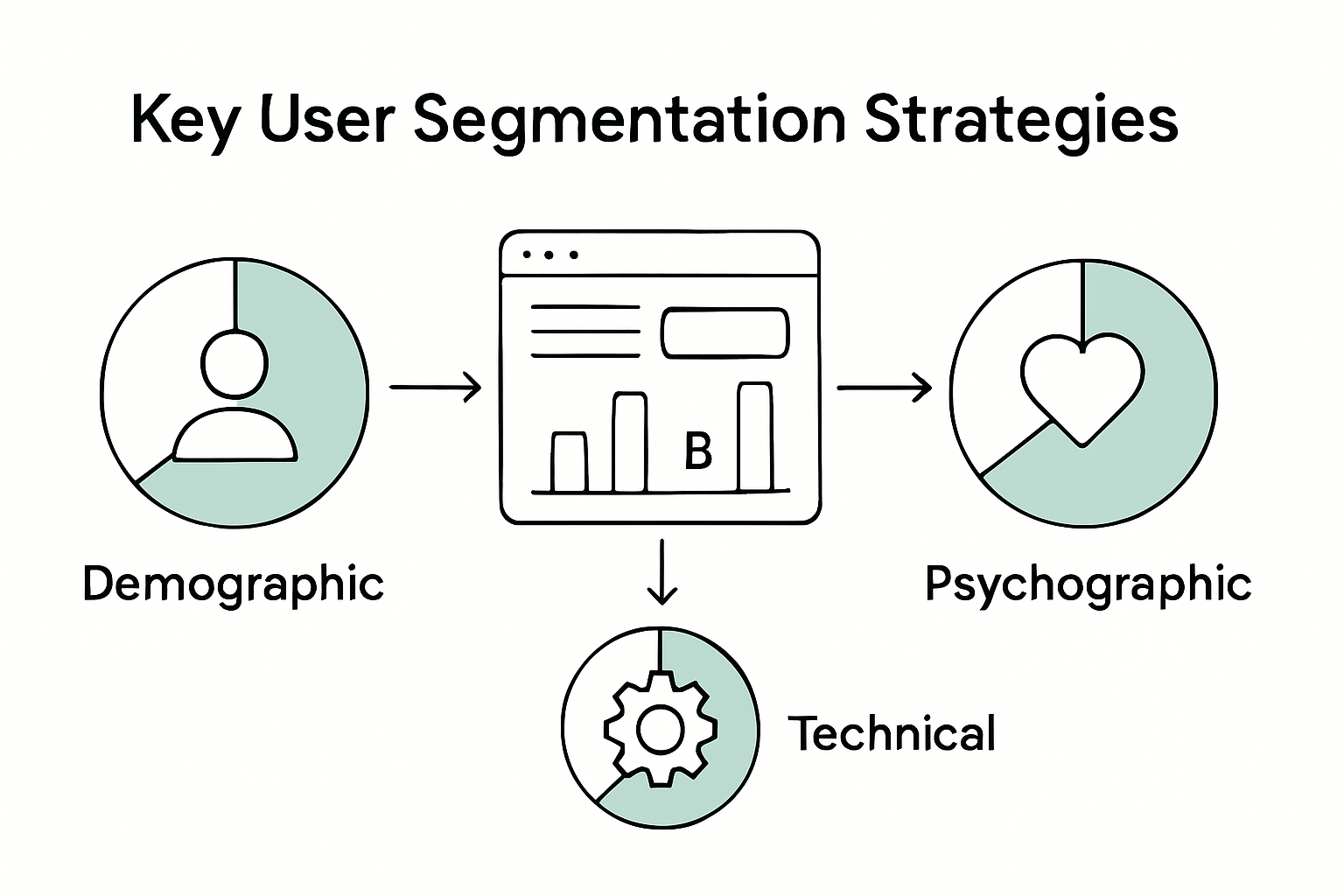
Demographic Segmentation represents the most fundamental approach, categorizing users based on quantifiable characteristics like age, gender, income, education level, and occupation. This method offers a straightforward way to divide audiences into distinct groups with potentially different preferences and behaviors.
Behavioral Segmentation delves deeper by analyzing user actions and interaction patterns. Key dimensions include:
- Purchase frequency
- Website engagement levels
- Feature usage
- Customer loyalty
- Conversion history
Psychographic segmentation takes a more nuanced approach, exploring psychological characteristics that influence user decisions. This strategy examines underlying motivations, values, attitudes, and lifestyle choices that traditional demographic data might miss. By understanding these deeper psychological drivers, marketers can create more resonant and personalized testing experiences.
Technical segmentation offers another critical perspective, focusing on users' technological environments. This approach considers factors like device type, browser, operating system, network connection speed, and geographical location. Such segmentation helps optimize user experiences across diverse technological landscapes, ensuring that A/B tests account for the significant variations in user technology interactions.

How User Segmentation Enhances Experimentation
Behavioral segmentation strategies revolutionize digital experimentation by enabling marketers to uncover nuanced insights that traditional one-size-fits-all testing approaches miss. Instead of treating all users as a monolithic group, segmentation allows for precision-targeted experiments that reveal complex interaction patterns and differential response mechanisms.
Heterogeneous Treatment Effects represent a critical advantage of user segmentation. By dividing audiences into distinct groups, businesses can identify how different segments respond uniquely to variations. For instance, a homepage redesign might significantly boost conversion rates for younger users while simultaneously decreasing engagement for older demographics. Without segmentation, these nuanced insights would remain hidden beneath aggregate data.
The segmentation process unlocks several key experimental enhancements:
- Targeted Personalization
- Reduced Statistical Noise
- More Precise Predictive Modeling
- Granular Performance Insights
- Customized User Experience Optimization
Machine Learning Integration further amplifies segmentation's experimental potential. Advanced causal analysis frameworks now leverage sophisticated algorithms to automatically detect and analyze subtle variations in user responses across different segments. This approach transforms A/B testing from a simplistic comparison tool into a sophisticated insights generation engine, allowing businesses to understand not just what changes work, but precisely why and for whom they work.
Practical Applications for Marketers and Growth
Growth marketing strategies rely heavily on user segmentation to transform broad audience data into targeted, actionable insights. By understanding distinct user characteristics, marketers can craft precision-driven campaigns that speak directly to specific audience subgroups, maximizing engagement and conversion potential.
Personalization Engines represent a powerful application of user segmentation. Top companies like Spotify and Airbnb demonstrate how microsegmentation techniques can revolutionize user experiences. These organizations create hyper-targeted recommendations by analyzing nuanced user behaviors, preferences, and interaction patterns, resulting in dramatically improved user satisfaction and retention rates.
Practical segmentation applications span multiple strategic domains:
- Product Development
- Targeted Marketing Campaigns
- User Experience Optimization
- Conversion Rate Enhancement
- Predictive Customer Behavior Modeling
Advanced marketers leverage segmentation to build sophisticated user journey maps that track and predict individual user progression. By breaking down large audiences into granular segments, businesses can develop more empathetic, responsive strategies that anticipate user needs before they arise. This proactive approach transforms traditional marketing from a reactive practice into a predictive, user-centric discipline that drives sustainable growth and meaningful customer connections.
Common Mistakes and How to Avoid Them
Digital marketing experiments can quickly become compromised by subtle yet critical errors in user segmentation. Understanding these pitfalls is essential for maintaining the integrity and reliability of your testing strategies.
Inadequate Sample Sizes represent a fundamental challenge in experimental design. Research indicates that poorly defined control groups and insufficient sample populations can introduce significant statistical biases that undermine the validity of experimental results. Marketers must carefully calculate and validate sample sizes to ensure meaningful, actionable insights.
Common segmentation mistakes include:
- Overgeneralizing User Groups
- Ignoring Statistical Significance
- Failing to Account for External Variables
- Insufficient Segment Diversity
- Premature Experiment Termination
Another critical error is the tendency to create segments based on surface-level characteristics without understanding deeper behavioral nuances. Effective segmentation requires a multidimensional approach that combines quantitative metrics with qualitative insights, allowing marketers to develop a more holistic understanding of user behavior and motivation. By recognizing and proactively addressing these common pitfalls, businesses can transform their user segmentation from a potential source of error into a powerful tool for strategic decision-making.
Unlock Smarter Decisions with Precision User Segmentation
Understanding user segmentation is crucial to uncovering hidden insights and driving effective A/B testing results. The article highlights challenges like inadequate sample sizes and overgeneralized groups that can dilute the impact of your experiments. If you want to go beyond basic demographic splits and leverage advanced behavioral and technical segmentation, you need a tool designed to simplify this complex process while delivering real-time, actionable data.
Discover how Stellar, the fastest A/B testing platform, empowers marketers and growth hackers to implement dynamic, granular segmentation without technical barriers. Its no-code visual editor and advanced goal tracking enable you to craft targeted experiments that reveal exactly what works for each user segment. Don’t let poor segmentation hold back your marketing success. Visit Stellar’s landing page now to start optimizing your campaigns with precision and ease. Take control of your user data today and make smarter decisions with confidence.
Frequently Asked Questions
What is user segmentation in A/B testing?
User segmentation in A/B testing is the process of dividing your audience into distinct groups based on shared characteristics such as demographics, behavior, and engagement. This approach enables marketers to craft more targeted experiments and understand how different user subsets respond to variations.
Why is user segmentation important for digital marketing?
User segmentation is important for digital marketing because it allows businesses to tailor their strategies to specific audience groups. By understanding the unique preferences and behaviors of different segments, marketers can create personalized experiences that improve engagement and conversion rates.
What are the key types of user segmentation strategies?
Key types of user segmentation strategies include demographic segmentation, which categorizes users based on quantifiable characteristics; behavioral segmentation, which analyzes user actions and patterns; psychographic segmentation, which focuses on psychological traits; and technical segmentation, which considers users' technological environments and devices.
How can businesses avoid common mistakes in user segmentation?
Businesses can avoid common mistakes in user segmentation by ensuring adequate sample sizes, avoiding overgeneralization of user groups, accounting for external variables, ensuring segment diversity, and developing a multidimensional approach that integrates both quantitative and qualitative insights.
Recommended
Published: 12/7/2025