
UX researcher role: methods, responsibilities, and business value
TL;DR:
- UX researchers analyze user behavior to inform data-driven business decisions.
- They focus on discovering user needs through qualitative and quantitative methods.
- Continuous research improves retention and reduces costly product failures for SMBs.
Most marketers and product managers at small to medium-sized businesses treat UX researchers as an optional luxury, someone brought in to "test a design" before launch. That framing misses the point entirely. A UX researcher studies user behaviors, needs, and product interactions to generate the data-driven insights that fuel real business decisions. They are not designers. They are not QA testers. They are the people who tell you why your A/B tests keep producing flat results, and what to test instead. This guide breaks down the role, the methods, and how to put UX research to work for your team.
Table of Contents
- What is a user experience researcher?
- Core responsibilities of a UX researcher
- Key methodologies: Generative, evaluative, and data triangulation
- Industry benchmarks and why continuous UX research matters
- Why SMBs undervalue UX research (and how to fix it)
- Level up your team's user experience research
- Frequently asked questions
Key Takeaways
| Point | Details |
|---|---|
| UX researchers drive business value | Their insights help teams make better decisions, improve products, and validate A/B tests with real user data. |
| Varied research methods | Generative and evaluative methodologies together reveal both user needs and effective solutions. |
| Continuous research boosts results | Ongoing studies increase user retention and ROI, even in small businesses with limited resources. |
| Implementation matters most | The true value of UX research is measured by how often findings drive action and change. |
What is a user experience researcher?
With that misconception addressed, let's define what a user experience researcher truly does, starting with the distinction that trips up most SMB teams.
A UX researcher's core job is to discover and validate user needs so that product and marketing decisions are based on evidence rather than assumption. They are not responsible for creating screens, writing copy, or building prototypes. That work belongs to the UX designer. The confusion happens because both roles sit inside the "UX" umbrella, but they require completely different thinking and different skills.
"A UX researcher investigates problems through research methods, while a UX designer creates solutions based on that research. These are not interchangeable roles. Researchers typically come from psychology or human-computer interaction backgrounds, and their daily work blends planning, sessions, analysis, and communication in roughly equal parts." Source
Think of it this way: if your UX designer is an architect drawing blueprints, your UX researcher is the structural engineer running soil tests before a single wall goes up. One creates. The other validates the ground conditions for creation.
Here is what the day-to-day work of a UX researcher actually looks like:
- Research planning: Writing research questions, defining what the team actually needs to learn, and choosing the right method to answer those questions correctly
- Participant recruitment: Identifying and securing the right users, which turns out to be one of the hardest parts of the job
- Conducting sessions: Running interviews, usability tests, contextual inquiries, or surveys depending on the research phase
- Data analysis: Synthesizing raw findings into patterns using methods like thematic coding and affinity mapping
- Communicating findings: Translating research into clear, actionable recommendations that stakeholders can actually use
That last point is where the advocacy function comes in. A UX researcher's job is not done when the data is collected. They act as the user's voice inside your team, pushing back when decisions contradict what users actually need. For user experience optimization to deliver real results, someone needs to own that advocate role. Without it, product decisions get made on gut feel, and A/B tests end up testing the wrong things entirely.
The business case for a dedicated researcher, even a part-time one, is that they prevent the expensive cycle of building, launching, failing, and rebuilding. They front-load the learning so your team makes fewer bad bets.
Core responsibilities of a UX researcher
Now that you know what a UX researcher is, let's break down what they actually do day to day, because understanding their responsibilities helps you make better use of their output.
Core responsibilities for a UX researcher include planning research, recruiting participants, conducting interviews and usability tests, analyzing data through thematic coding and affinity mapping, and communicating findings to stakeholders in ways that drive decisions. Recruiting alone is a problem for 61% of research teams, making it one of the biggest time sinks in the entire practice.
Here is a breakdown of major activities and typical time allocation:
| Responsibility | Time allocation | Common challenge |
|---|---|---|
| Research planning and question design | 20% | Writing questions that don't lead users |
| Participant recruitment | 15-25% | Finding qualified users fast |
| Running sessions (interviews, tests) | 30% | Keeping sessions neutral and on track |
| Data analysis and synthesis | 30% | Moving from raw data to clear themes |
| Reporting and stakeholder communication | 20% | Translating research into decisions |
The numbers add up to more than 100% intentionally. In practice, these activities overlap, and SMB researchers often carry multiple responsibilities simultaneously without a research ops function to support them.
For SMB teams with thin resources, the recruitment problem is the most common bottleneck. Building a user panel takes time and budget. Many teams skip recruitment entirely and test with whoever is available internally, which produces biased results and kills the value of the research.

Pro Tip: Use self-serve unmoderated testing tools and pre-built participant panels to cut recruitment time from weeks to days. Platforms that let users record their own sessions asynchronously can give you five to eight usable responses in 48 hours without scheduling a single live call. This approach works especially well for evaluative research, where you already have a prototype or live page to test.
Your user journey optimization efforts depend on getting accurate data from real users, not from internal opinions. Even a lightweight research practice, running two to three studies per quarter, gives your team the evidence it needs to prioritize improvements that actually move metrics.
The communication step is also where many SMB researchers lose impact. Delivering a 40-slide deck of findings to a marketing team that needs to make a decision by Friday is not effective. Strong researchers build summary reports, highlight reels from session recordings, and one-page insight sheets that busy teams can act on quickly.
Key methodologies: Generative, evaluative, and data triangulation
Understanding responsibilities sets the stage for exploring how UX researchers gather actionable evidence, which brings us to the methodology question that confuses most non-researchers.
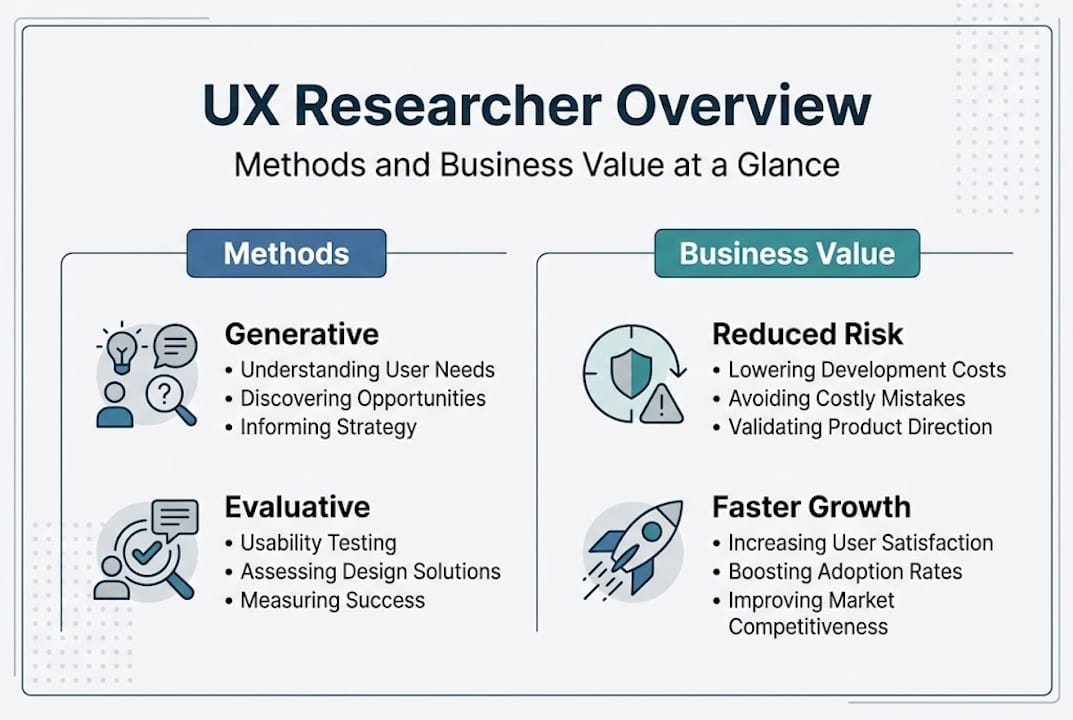
UX research methods fall into two broad categories: generative and evaluative. They serve different purposes, and mixing them up is one of the most common mistakes SMB teams make when running their own informal research.
Key methodologies break down as follows: generative research, which includes interviews, contextual inquiry, and diary studies, is used to discover needs before you have a solution. Evaluative research, which includes usability testing, A/B tests, and surveys, is used to validate solutions you have already built. Qualitative methods answer why and how and work best with small samples of five to eight participants. Quantitative methods answer how many and how often and require at least 100 respondents to produce statistically significant results.
| Method type | Best for | Sample size | Example methods |
|---|---|---|---|
| Generative qualitative | Discovering problems | 5-8 per segment | User interviews, diary studies |
| Evaluative qualitative | Finding friction in a solution | 5-8 per segment | Usability testing, think-aloud sessions |
| Evaluative quantitative | Measuring behavior at scale | 100+ | Surveys, A/B tests, analytics |
Here is a practical numbered framework for matching method to business question:
- Start with the question, not the method. Define what you need to learn before picking a research type. "Why are users dropping off at checkout?" requires generative research. "Does button color affect conversions?" requires evaluative quantitative testing.
- Use qualitative research to generate hypotheses. Run five to eight interviews or usability sessions to identify the friction points and motivations you did not already know about.
- Use quantitative research to validate at scale. Once you have a strong hypothesis from qualitative work, test it with A/B testing or a large survey to confirm the finding holds across your broader user base.
- Triangulate across methods before making a major decision. When qualitative, quantitative, and behavioral data all point in the same direction, you have a high-confidence signal worth acting on.
For UI testing at SMBs, triangulation is particularly valuable because small teams often lack the statistical power for large-scale quantitative research alone. Combining five usability sessions with analytics data and a short survey gives you a much richer picture than any single method could provide.
Pro Tip: If you cannot recruit real users quickly enough for generative research, AI-generated synthetic personas based on your actual customer data can help you stress-test assumptions before investing in full research cycles. This is not a replacement for real users, but it works well as a low-cost hypothesis generator. The key is to follow synthetic persona work with at least a small round of real user validation before making major product or marketing decisions. Experimenting with UX becomes far more efficient when your hypothesis is grounded in real evidence rather than internal debate.
Industry benchmarks and why continuous UX research matters
Having covered methods, let's look at real-world numbers and ongoing research's business impact, because the ROI of UX research is often the missing piece when SMBs decide whether to invest.
The research is clear on sample sizes: usability testing finds 85% of usability issues with just five participants per user segment, interview saturation typically occurs between 12 and 20 sessions, and surveys need 100 to 400 respondents to reach statistical significance. Most SMBs dramatically over-invest in sample size for qualitative work and under-invest in quantitative research when they need to measure behavior.
The same benchmark data shows that 72% of research teams conduct usability testing two to three times per quarter. Continuous research at that cadence is linked to retention improvements of 3.6% to 10.8% over a three-year period. That number deserves attention. For a business with 10,000 active customers, a 5% retention improvement can meaningfully shift annual revenue without acquiring a single new user.
Key benchmarks for SMB research programs:
- 5 users per segment surfaces 85% of usability issues in a single test round
- 12 to 20 interview sessions typically reach saturation for qualitative themes
- 100 to 400 survey responses needed for statistically significant quantitative findings
- 72% of teams test two to three times per quarter as standard practice
- Continuous research programs drive 3.6% to 10.8% retention improvement over three years
Retention impact of continuous UX research: up to 10.8% improvement over 3 years. For most SMBs, improving retention is far cheaper than improving acquisition, making research one of the highest-ROI investments available.
The connection to UX and conversion rates is direct. When you understand what users expect at each stage of their journey, you can design and test experiences that meet those expectations instead of guessing. Teams that run research continuously report faster A/B test cycles because they enter each experiment with a sharper hypothesis. They waste fewer tests on changes that have no theoretical basis and see stronger results from the tests they do run.
The practical wins from continuous user feedback include:
- Identifying navigation confusion before it shows up in bounce rate data
- Catching copy that does not resonate with users before paid traffic campaigns go live
- Validating new features with a small user group before full rollout
- Prioritizing product roadmap items based on actual user pain points rather than internal assumptions
Data-driven marketing starts with data that accurately reflects user behavior and intent. Research gives you that foundation, and without it, even the most sophisticated analytics setup is answering the wrong questions.
Why SMBs undervalue UX research (and how to fix it)
These numbers show why research matters, but the real obstacle is how SMBs perceive its value. Most smaller teams see UX research as something large companies do, a luxury that requires a full team, a budget, and months of runway. That perception is wrong, and it is costing them.
The hidden cost of skipping research is not zero. It shows up in A/B tests that run for weeks and produce no winner because the underlying hypothesis was never validated. It shows up in product features that get built and barely used. It shows up in landing pages that get redesigned three times because no one asked users what they actually wanted before the first redesign.
The number worth tracking is implementation rate: the percentage of research recommendations that actually get acted on by the team. Research ops data shows that research and recruiting operations consume 40% to 50% of a researcher's total time, and the benchmark implementation rate for high-performing teams sits at 60% to 80%. If you are running research but fewer than half of your findings are influencing decisions, you have a communication and prioritization problem, not a research problem.
For resource-constrained SMB teams, the fix is practical. Start with UX testing for growth by using unmoderated tools to cut research ops time in half, focus on two to three high-priority questions per quarter rather than trying to research everything, and report findings in one-page formats that busy marketing and product teams can read in five minutes. Measure your implementation rate from day one. When leadership sees that research recommendations are influencing decisions that move metrics, the budget conversation becomes much easier.
Level up your team's user experience research
Ready to put these insights into action? Understanding what a UX researcher does is the first step. The second is having the right tools to run fast, reliable experiments on what your research uncovers.
Stellar is built for exactly this: turning research insights into tested, validated results without needing a developer or a large team. With a no-code visual editor, real-time analytics, and a lightweight 5.4KB script that won't slow your site down, Stellar gives marketers and product managers at SMBs the power to run A/B tests that are grounded in real user evidence. Whether you are validating a copy change from your last usability session or testing a new page flow from your interview findings, Stellar makes experimentation fast and accessible, including a free plan for businesses under 25,000 monthly tracked users.
Frequently asked questions
How is a UX researcher different from a UX designer?
A UX researcher investigates user problems through research methods, while a UX designer creates solutions based on that research. The roles are not interchangeable and require different training, mindsets, and skill sets.
What skills are essential for a user experience researcher?
Core skills include behavioral research methods, data analysis, empathy, and strong communication. Researchers typically come from psychology or human-computer interaction backgrounds and split their time across planning, sessions, analysis, and stakeholder communication.
What are the biggest challenges UX researchers face at SMBs?
Recruiting qualified participants is the top challenge, with 61% of teams struggling to find the right users. Limited time for analysis and thin research ops support compound the problem for smaller teams.
How large should a sample size be for usability testing?
Five users per segment is enough to surface about 85% of usability issues in a single round of testing, making small-sample research practical and affordable for SMBs.
Recommended
Published: 4/26/2026