
VWO Morningstar Confusion? Check Script Size and Ship Tests Safely
"VWO Morningstar" refers to VWO, the Visual Website Optimizer A/B testing platform, not the Morningstar fund data tied to Vanguard's emerging markets ticker of the same letters. If you landed here from that search, your next move is to check the platform's script size, its deployment workflow, and how it handles analytics before you commit to a trial. The rest of this guide walks through why that confusion happens and what to verify.
TL;DR:
- Visual editor platforms like VWO rely on scripts that can create dependencies, performance issues, and shadow codebases if not promoted into actual code.
- Evaluating a testing platform requires checking script size, load behavior, analytics real-time updates, and support for custom integrations before adoption.
- Shipping a winning experiment safely involves code promotion, scheduled audits, clear ownership, and having a rollback plan to prevent technical debt.
- Visual editors are best suited for quick, temporary marketing tests, while engineering-supported teams should treat them as prototypes rather than permanent solutions.
- Stellar offers a lightweight, no-code test platform with transparent pricing and analytics, addressing common performance and workflow concerns linked to VWO-style tools.
Table of Contents
- Why the search results mix finance data with a testing tool
- The hidden risks of visual-editor based testing
- A checklist for evaluating VWO or any testing platform
- How to ship winning experiments without creating technical debt
- When a visual editor makes sense and when it doesn't
- Where Stellar fits if you're comparing VWO-style tools
- Further reading for your evaluation
- FAQ
Why the search results mix finance data with a testing tool
The letters "VWO" belong to two unrelated products: Visual Website Optimizer, a conversion optimization tool for marketers, and the ticker symbol for an emerging markets fund that Morningstar covers extensively. Search engines treat "VWO" as a single token and surface whichever result has more authority or volume for a given query, which is why finance content sometimes outranks product pages for mixed search terms like this one.
If you're a marketer, growth hacker, or product manager, you can safely ignore any Morningstar or exchange-traded fund coverage that surfaces under this phrase. None of it applies to conversion testing, experiment design, or website performance.
This article covers only the Visual Website Optimizer meaning. That includes:
- How visual editor platforms apply changes to your site
- The operational risks of relying on a vendor script long term
- A checklist for evaluating VWO or any similar tool
- A practical playbook for shipping winning experiments safely
The hidden risks of visual-editor based testing
Visual editor platforms, including VWO, typically apply changes at runtime in the browser through a vendor script rather than by editing your site's actual source code. That approach makes experiment setup fast, but it creates dependencies that are easy to miss until something breaks.
- Subscription dependency: if winning variants exist only inside the testing script, canceling the subscription or losing the script removes those changes from your live site.
- Shadow codebase buildup: without a formal process to promote winners into your actual code, you accumulate browser-side logic that your engineering team never reviewed, which experts describe as a maintenance liability over time.
- Performance drift: long-running experiments can quietly degrade page speed, especially when multiple scripts stack up across different campaigns.
- Analytics mismatch: visual editors sometimes report results on a different timeline than your core analytics platform, which can lead teams to ship a "winner" that looks different once validated elsewhere.
Run a quick audit: open your site's developer tools, look for DOM elements that only appear when the testing script loads, and ask whether those elements have a matching pull request in your codebase. If they don't, you have a shadow experiment running in production.
Pro Tip: Treat every visual-editor change as temporary until it has a corresponding code change and a deploy ticket. If it's been live for more than a quarter without one, it's a liability, not a test.
A checklist for evaluating VWO or any testing platform
Before adopting any A/B testing tool, run it through a short technical and operational review. Script weight and loading behavior matter most because they affect every visitor on every page the tool touches.
- Measure the vendor's script size and confirm it loads asynchronously with a fallback if it fails, since a lightweight script reduces the performance risk tied to running experiments.
- Ask the vendor what their recommended promote-to-prod workflow looks like and whether changes are auditable outside the visual editor.
- Confirm the analytics dashboard updates close to real time and supports segmentation that matches how your team measures success.
- Check integration coverage with your CMS or e-commerce platform and whether developers can extend the tool with custom code when needed.
- Review pricing tiers against your monthly tracked user volume, and confirm where the free plan threshold sits before you hit a paywall mid-test.
- Verify that dashboards still require you to check statistical significance and segment-level effects rather than declaring a winner automatically.
None of these checks take more than an afternoon, and skipping them is how teams end up locked into a tool that doesn't fit their stack six months in.
How to ship winning experiments without creating technical debt
Running the experiment is the easy part. Shipping the winner safely, and retiring the test cleanly, is where most teams lose discipline.
- Assign an experiment owner and define release criteria before the test launches, including what counts as a win and who signs off on shipping it.
- When a variant wins, write the equivalent code change, send it through code review, and deploy it via your normal CI/CD pipeline before disabling the rule in the visual editor.
- Tag every active experiment and schedule a recurring audit, monthly or quarterly, to find and remove tests that have quietly gone stale.
- Roll production changes out gradually and keep a rollback plan ready in case the "winning" variant behaves differently at full traffic than it did in the test.
Operational controls that reduce risk include experiment tagging, scheduled audits to remove stale tests, ownership assignment, and a documented promote-to-prod flow, and teams that skip these steps are the ones who find orphaned scripts running years-old tests nobody remembers approving.
Build automated checks, whether in CI or as a scheduled job, that flag DOM mutations persisting only through the testing script with no matching deploy record. That single habit catches most shadow-codebase problems before they become a cleanup project.
When a visual editor makes sense and when it doesn't

Visual editors earn their keep for marketing-only teams that need to launch tests without waiting on engineering, and for quick experiments with a short shelf life. The trade-off is maintainability: speed now, cleanup debt later if nobody owns the promote-to-prod step.
Teams with engineering support should treat the visual editor as a prototyping layer, not a permanent home for winning changes. Before trialing any platform, verify its performance claims yourself rather than taking a vendor's script-size number at face value.
— Juan
Where Stellar fits if you're comparing VWO-style tools
If the checklist above left you wanting a platform built around the performance and workflow concerns it raises, that's the gap Stellar is built to close. It runs on a lightweight script, among the lightest in the category by its own measurement, and pairs that with a no-code visual editor so marketing teams can launch tests without opening a ticket.
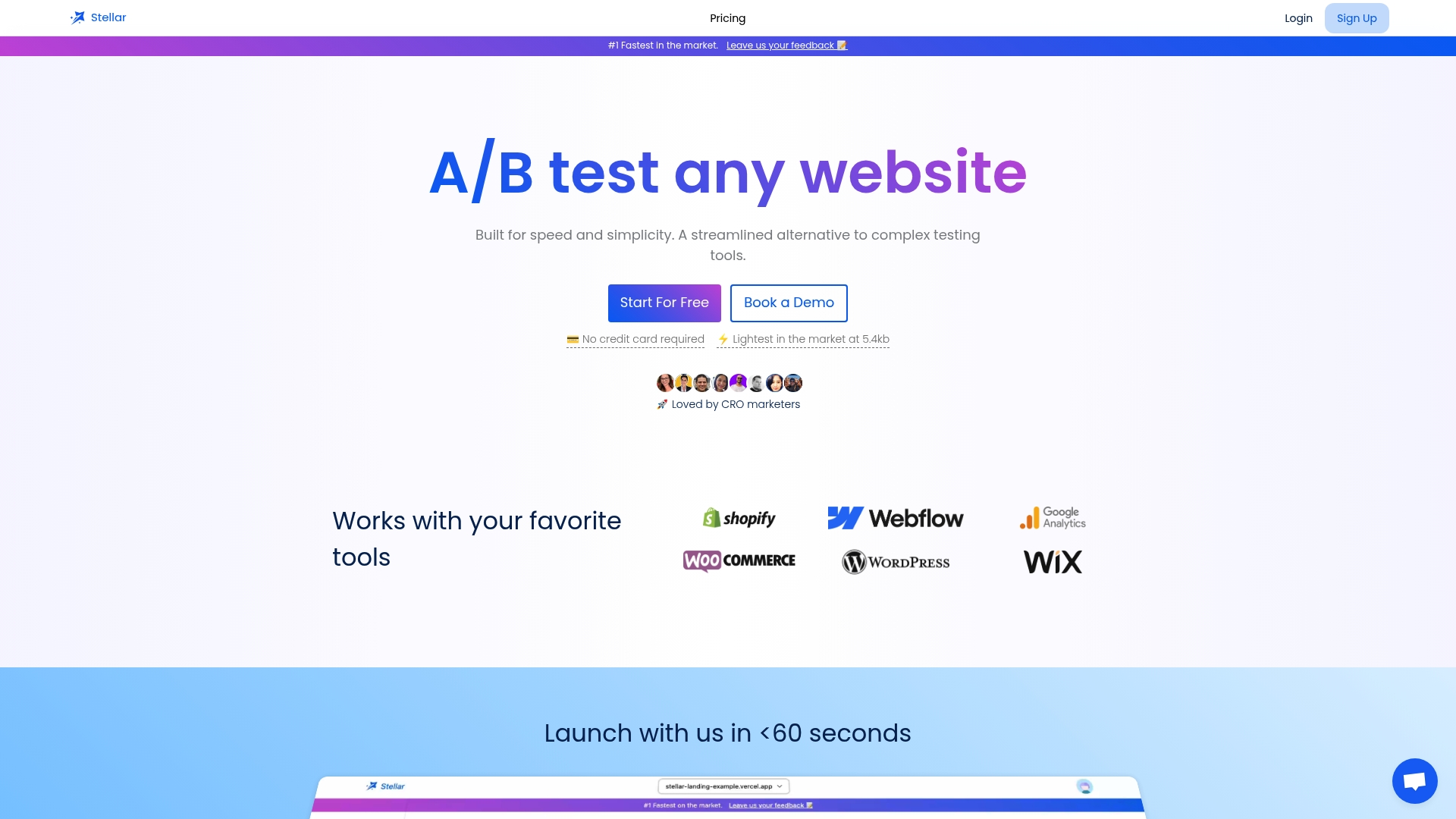
- A visual editor for setup without developer time
- A small script designed to minimize load impact during experiments
- Analytics for faster read on test results
- A free plan with a limited number of monthly tracked users
That combination addresses three items from the checklist directly: script weight, editor accessibility, and pricing clarity before you commit. Compare plans, including Sandbox, Plus, Pro, and more, and start on the free plan to see how it handles your traffic.
Further reading for your evaluation
- VWO A/B testing guide for SMB marketers: deeper how-to on running experiments.
- Visual editor guide for marketers: practical setup tactics.
FAQ
Does "VWO Morningstar" relate to the Vanguard emerging markets fund?
No, not for this topic. Here it refers to Visual Website Optimizer, an A/B testing platform for marketers, and has nothing to do with fund ratings or ticker data.
What happens if I cancel my A/B testing subscription?
Any winning variant that only exists inside the visual editor's script disappears once the subscription or script stops running. That's why teams are advised to promote winners into their site's actual codebase rather than leaving them live only in the test tool.
How do I know if a testing platform will slow down my site?
Check the vendor's script size and confirm it loads asynchronously with a fallback if it fails to load. A lighter script, such as the lightweight figure Stellar cites for its own platform, reduces the performance risk tied to running experiments.
What's the safest way to make a winning test permanent?
Write the equivalent change as real code, run it through code review and your normal deploy pipeline, then disable the rule in the visual editor. Skipping that step is how teams end up with changes that only exist inside a vendor script.
Is there a free way to start testing before committing to a platform?
Yes, many platforms offer a free tier for lower traffic volumes, Stellar's free plan covers businesses under 25,000 monthly tracked users. That gives you room to validate script performance and workflow fit before paying for a higher tier.
Recommended
Published: 10/1/2026