
Web UX for Marketers: A/B Testing and Optimization Guide
What web UX actually means for growth-focused marketers
Web UX is not about making a site look good. It is about whether users can accomplish their goals without friction, confusion, or frustration. The Nielsen Norman Group defines UX as the holistic interaction experience, something that extends well beyond visual aesthetics into how a site feels, performs, and responds to real human needs.
For marketers and growth hackers, that distinction matters practically. Web design controls what users see. Web UX controls what they do, how long they stay, and whether they convert.
The core attributes that drive UX quality include:
- Usability: Can users navigate intuitively and complete tasks without guessing?
- Accessibility: Does the site work for users with different abilities and devices?
- Interactivity: Do interface elements respond predictably and quickly?
- Content clarity: Is the message scannable, relevant, and free of jargon?
- Technical performance: Does the page load fast enough to hold attention?
UX metrics now directly affect organic search performance. Google weighs dwell time, interaction quality, and Core Web Vitals as ranking signals. That means a sluggish, confusing site does not just lose conversions. It loses rankings too.
Treating UX as a one-time project is a mistake most marketing teams make once. The sites that compound growth treat it as a continuous strategy: design, test, measure, repeat.
Table of Contents
- Common UX misconceptions that hurt marketing results
- How to apply A/B testing effectively to improve web UX
- Best practices for web UX design and A/B testing in 2026
- Gostellar makes UX experimentation faster without the overhead
- Key Takeaways
Common UX misconceptions that hurt marketing results
Even experienced teams carry assumptions about user experience design that quietly undermine their experiments.
- UX equals UI. The most persistent myth. UI is the button, the color, the layout. UX is whether the button appears at the right moment, in the right context, for the right user. Conflating them leads to redesigns that look polished but convert worse.
- UX is a one-off deliverable. Launching a redesign is not finishing UX work. User behavior shifts, traffic sources change, and what worked in Q1 may drag by Q3. UX requires ongoing monitoring and iteration.
- Chat interfaces solve everything. Smashing Magazine warns against conversational tunnel vision: defaulting to chat-style interfaces regardless of context. A chatbot on a product comparison page adds cognitive load, not clarity. Match the interface modality to what the user actually needs at that moment.
- Core Web Vitals are a developer problem. Marketers who ignore Largest Contentful Paint and Interaction to Next Paint hand their competitors a ranking advantage. These metrics are UX metrics, and they belong in every growth team's dashboard.
- Accessibility is optional. Skipping it shrinks your addressable audience and increases legal exposure. Integrating accessibility annotations early in design costs far less than retrofitting them after launch.
- New trends beat foundational usability. Scroll-jacking, parallax overload, and auto-playing video are recurring offenders. Novelty rarely outperforms clarity when conversion is the goal.
How to apply A/B testing effectively to improve web UX
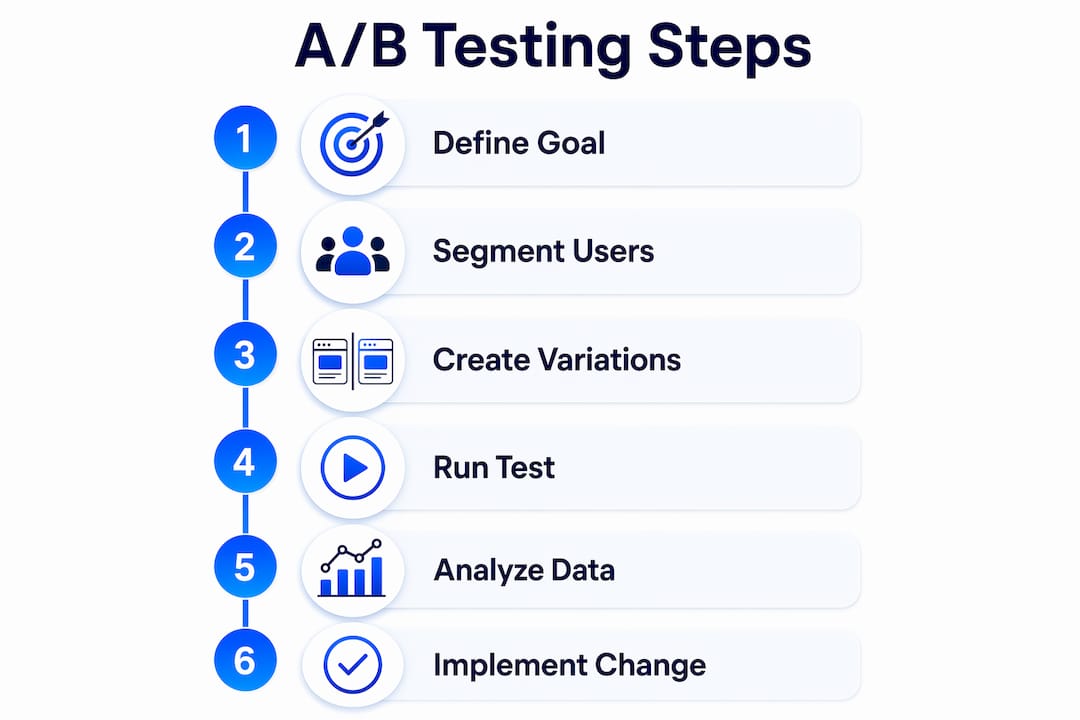
A/B testing without a UX hypothesis is just guessing with extra steps. The process works when it starts with a specific problem, not a vague hunch.
- Ground every test in data. Heatmaps, session recordings, and funnel drop-off reports tell you where users struggle. That is where your hypothesis comes from, not from gut instinct or what a competitor is doing.
- Segment before you test. Running one test across your entire audience blurs the signal. New visitors behave differently from returning users. Mobile users have different friction points than desktop users. User segmentation reduces variance and makes results far more interpretable.
- Pick KPIs that match the UX goal. Conversion rate, scroll depth, form completion rate, and time-to-first-interaction all measure different things. Choose the metric that reflects the specific behavior you are trying to change.
- Respect statistical significance. Calling a test early because the variant looks better is one of the most common errors in growth teams. Wait for significance, and account for multiple testing bias if you are running several experiments simultaneously.
- Avoid manipulative test designs. Dark patterns, fake urgency, and deceptive defaults may lift a metric short-term. They erode trust and inflate churn. Ethical experimentation means testing experiences you would be comfortable showing to your users transparently.
- Use the right platform. No-code A/B testing tools with visual editors let marketing teams run experiments without waiting on engineering. Speed of iteration is a competitive advantage.
Pro Tip: Removing a single field from a form can increase conversion rates by 10–25%. Form simplification is consistently one of the highest-leverage UX tests you can run, and it takes less than an hour to set up. Research from Forrester suggests that marketers who improve UX systematically through A/B testing can improve conversions by up to 400%, reflecting the dramatic upside of targeted optimization.
Best practices for web UX design and A/B testing in 2026
The fundamentals have not changed. What has changed is the bar for execution.
- Mobile-first is non-negotiable. A significant portion of web traffic is mobile. Design for the smallest screen first, then scale up. Performance follows the same logic: Largest Contentful Paint under 2.5 seconds is the threshold for acceptable UX by current Core Web Vitals standards.
- Interaction speed matters at the millisecond level. Google's Interaction to Next Paint metric expects responses within 200ms. Anything slower registers as lag to users, even if they cannot articulate why the site feels off.
- CTAs should reflect what users already want. Button copy informed by user behavior data outperforms generic labels. "Start my free trial" converts better than "Submit" because it mirrors the user's intent, not the system's action.
- Personalization is now a baseline expectation. Dynamic content tailored to traffic source, device, or prior behavior consistently outperforms static pages in head-to-head tests. Dynamic keyword insertion on landing pages is one of the faster ways to close that gap.
- Align UX experiments with SEO strategy. UX and organic growth are not separate workstreams. Improving page speed, reducing bounce rate, and increasing engagement time all feed into ranking signals. Test with both conversion and SEO metrics in view.
- Real-time analytics shorten the feedback loop. Waiting a week for a report means a week of running a losing variant. Real-time data lets teams pause, pivot, or scale winning experiments faster.
- Continuous improvement beats periodic overhauls. The teams winning on UX in 2026 are not the ones who launched a great redesign. They are the ones running three to five experiments per month, compounding small gains into measurable growth.
Gostellar makes UX experimentation faster without the overhead
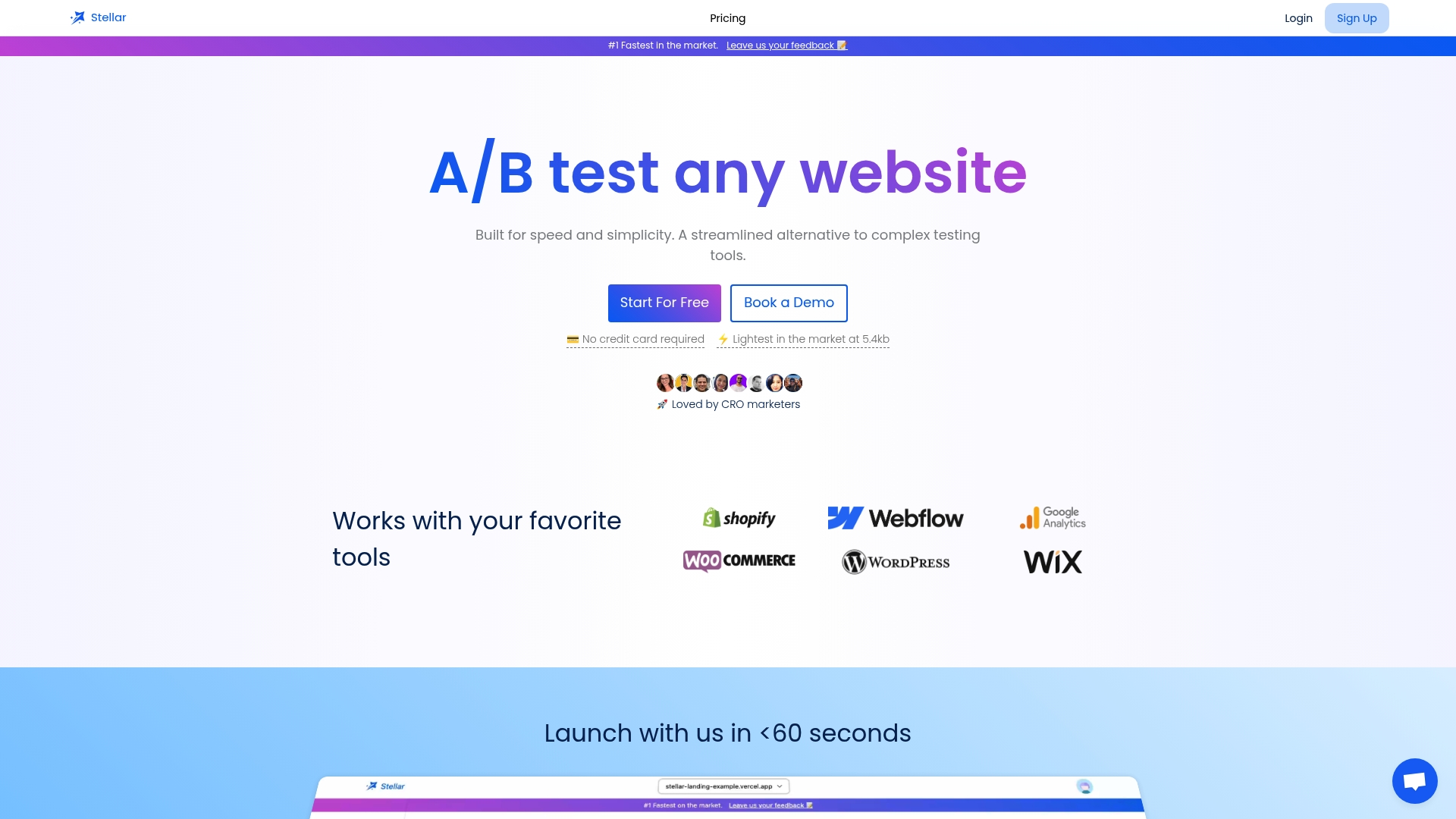

Most A/B testing platforms were built for engineering teams. Gostellar was built for marketers who need results without a sprint cycle. Its 5.4KB script adds virtually no load to your pages, which means your experiments do not compromise the very UX metrics you are trying to improve.
The no-code visual editor lets you set up and launch tests directly on your live site. No developer handoff, no delay. Dynamic keyword insertion lets you personalize landing pages for different traffic segments without building separate pages. Advanced goal tracking ties every experiment to the metrics that actually matter for your business, and real-time analytics surface results as they happen.
Gostellar's free plan covers businesses with under 25,000 monthly tracked users, making it a practical starting point for growth teams at small and medium-sized businesses. For teams ready to run more experiments at higher traffic volumes, paid tiers scale accordingly.
If your UX optimization strategy depends on fast, clean experimentation, start a free trial at gostellar.app.
Key Takeaways
Continuous, data-driven UX experimentation, grounded in segmentation and statistical rigor, is the most reliable path from traffic to conversion growth.
| Point | Details |
|---|---|
| UX vs. design | Web UX measures whether users achieve goals; visual design controls what they see. |
| Form simplification | Removing one form field can increase conversion rates by 10–25%, making it a high-priority test. |
| Statistical discipline | Call tests only at significance; early reads are one of the most common errors in growth teams. |
| Performance thresholds | Largest Contentful Paint under 2.5 seconds and INP under 200ms are the current UX benchmarks. |
| Gostellar | A 5.4KB no-code A/B testing platform built for marketers who need fast experimentation without engineering support. |
Recommended
Published: 7/23/2026