
Marketers: Cross Platform Website and Mobile App Tests in 48 Hours
In this article, "website mobile application" refers to running A/B experiments across your website and native mobile apps at the same time. The best first move is a focused test with one primary metric, a staggered roll-out and short iteration cycles rather than one long, sprawling experiment. If your product has social or marketplace features, plan for interference before you launch, since standard designs can mislead you there.
TL;DR:
- Conduct synchronized experiments across web and mobile only when users share a common ID and the test covers the entire funnel; otherwise, run platform-specific experiments.
- Use a phased rollout starting at 1-5% traffic, then increase to 20% and full rollout only after confirming guardrails remain stable during each phase.
- Account for interference in social, marketplace, or shared resource environments by employing cluster-based randomization techniques to reduce bias in results.
- Ensure your primary metric directly measures behavior change and pre-register hypotheses to prevent bias and false positives.
- Use lightweight, fast-loading scripts and test on actual devices to preserve data integrity, optimize performance, and improve test reliability across platforms.
Table of Contents
- Why cross-platform experimentation matters for marketers and product teams
- Step-by-step workflow to design and run cross-platform experiments
- When standard A/B tests fail: interference, marketplaces, and cluster-based alternatives
- Measurement and decision rules: cutting false positives
- 48-hour quickstart checklist and internal resources
- Benefits and limitations of website mobile applications
- Common use cases and industries leveraging website mobile applications
- Technical considerations for developing website mobile applications
- UX best practices specific to website mobile applications
- Performance optimization techniques for website mobile applications
- Running fast, low-friction experiments in practice
- Try Stellar for fast, low-friction testing across web and mobile
- FAQ
- Sources
Why cross-platform experimentation matters for marketers and product teams
Running coordinated experiments across web and mobile gives you three concrete advantages: lower launch risk, faster feedback, and more accurate measurement. A staggered release lets you catch a broken checkout flow or a crashing screen before it reaches your whole audience, and shorter iteration cycles mean you learn and adjust in days instead of months, a pattern HBS research on iterative experimentation associates with meaningfully more value than isolated, one-off tests.
Web and mobile are not the same delivery problem, though. On the web, you typically rely on a client-side script and a visual editor to swap copy, layout, or offers in real time. On mobile, you need an SDK or remote-config layer, and your attribution windows often run longer because app review cycles and install lag change how fast a variant reaches real users.
- Run unified experiments when a user moves between web and app with a shared ID and you're testing one funnel end to end.
- Run separate experiments when the platforms serve different jobs, like browsing on web and transacting in-app.
- Default to platform-specific guardrails even inside a unified test, since a mobile crash rate and a web bounce rate are not interchangeable signals.
Step-by-step workflow to design and run cross-platform experiments
A good cross-platform test follows the same shape every time: design, deliver, ramp, analyze, iterate. Treat this as a runbook rather than a one-time checklist.
- Pick one hypothesis and one primary metric. Decide what you expect to change and how you'll know, then set guardrail metrics (crash rate, load time, support tickets) before touching any variant.
- Choose your delivery mechanism. On web, a lightweight script paired with a no-code visual editor keeps page speed intact; on mobile, use an SDK or remote-config so you can turn variants on and off without shipping a new build.
- Ramp gradually. Start at 1% to 5% of traffic, watch for a day or two, move to around 20%, then go to full rollout once guardrails hold steady, a pattern consistent with staggered roll-out practices documented in marketplace and social network experiments.
- Plan sample size and duration before launch. As a rule of thumb, run long enough to cover at least one full weekly cycle of user behavior, and loop in an engineer or analyst when your baseline conversion rate is low or your audience is small.
- Iterate in short cycles. Treat each test as one entry in an ongoing sequence rather than a single verdict, since stacking short experiments tends to compound gains over time.
Pro Tip: Lock your primary metric and sample-size plan in writing before you look at any results, so you're not tempted to shift the goalposts mid-test.
For mobile-specific setup details, our mobile app A/B testing guide walks through onboarding and messaging experiments step by step, and choosing the right testing tool can help you match an SDK to your app's architecture.
When standard A/B tests fail: interference, marketplaces, and cluster-based alternatives
Standard A/B testing assumes one user's experience doesn't affect another's. That assumption breaks down in social feeds, marketplaces, or any product where inventory or attention is shared. Watch for these signals that interference may be present:
- Users interact directly, such as sharing content, messaging, or referring one another.
- A limited resource, like inventory or ad slots, gets reallocated between treatment and control groups.
- One variant appears to cannibalize results in the other arm faster than expected.
Research on interference in platform experiments found that spillover effects can bias naive estimates by as much as the treatment effect itself, which means a test that looks like a clear win might be measuring noise instead.
When you suspect interference, cluster-based randomization, where you randomize groups of connected users instead of individuals, helps contain spillovers, though it comes with a trade-off: fewer independent units means higher variance in your results. Clustering algorithms such as Balanced Louvain are built specifically to minimize cross-cluster contamination while keeping clusters balanced in size. Estimators like CUPAC and DQ can also help recover statistical power without requiring you to redesign your entire data pipeline. Decision-making research on inventory-constrained platforms shows these dependencies also raise your false-positive risk, so escalate to engineering or data science as soon as shared inventory, social graphs, or marketplace dynamics show up in your product.

Measurement and decision rules: cutting false positives
Picking the right metric matters more than picking a clever one. Your primary metric should map directly to the behavior you're trying to change, whether that's checkout completion, trial signups, or a specific funnel step, and your guardrails should cover anything a regression could quietly break, like app crash rate or page load time.
- Run an A/A test before your first real experiment to confirm your instrumentation isn't introducing bias on its own.
- Pre-register your hypothesis and primary metric so you're not shopping for a significant result after the fact.
- Segment your results by platform, device, and new versus returning users before declaring a winner.
- Set a rollback trigger in advance, such as a crash rate spike or a conversion drop past a defined threshold.
Ramped releases double as a confidence check: if your metric holds steady from 5% to 20% to full traffic, you have more reason to trust it. Iterative experimentation compounds this effect, since the HBS framework applied to LinkedIn's experimentation program found that short, repeated iterations on a single area added measurable gains beyond what a single test would have captured.
Pro Tip: Run a holdout group even after you ship a winning variant, so you can confirm the lift persists once novelty wears off.
48-hour quickstart checklist and internal resources
You can get a first cross-platform experiment live in two days if you work through these tasks in order.
- Write one hypothesis and name the single primary metric it affects.
- Choose your delivery mechanism: web script and visual editor, or mobile SDK and remote config.
- Set your ramp schedule (1% to 5%, then 20%, then full) and write down your rollback triggers.
- Validate instrumentation with an A/A test or a dry run before real users see a variant.
- Set up a simple monitoring dashboard tracking your primary metric plus two or three guardrails.
For variant ideas, our landing page testing ideas and high-impact A/B testing examples are good starting points, and boosting app UX through testing covers mobile-specific variants. During your ramp, watch for sudden drops in conversion, spikes in crash reports, and any guardrail metric moving outside its normal range.
Benefits and limitations of website mobile applications
Testing across both channels gives you a fuller picture of how a change performs where your customers actually are, since a checkout redesign that lifts web conversion might do nothing for app users who skip the browser entirely. You also get faster, more reliable learning: a staggered rollout catches problems early. Because you're testing in two environments, you can isolate whether a result is platform-specific or holds everywhere.
The limitations are mostly operational. Running tests on both platforms doubles your setup and monitoring work unless your tooling supports both from one dashboard. Mobile experiments usually require SDK integration or remote-config support, which adds a dependency your web tests don't have, and app store review timelines can delay how fast a new variant reaches users. Attribution also gets harder: a user who sees a web ad and later converts in-app needs a shared identifier to track correctly, and without one, your data understates true impact.
Small teams often solve this by starting with whichever platform drives the most revenue, proving out the workflow there, then extending it to the second platform once the process is stable. Trying to launch identical tests on both channels on day one usually means neither gets done well.
Common use cases and industries leveraging website mobile applications
E-commerce teams rely on cross-platform testing constantly, comparing checkout flows, shipping messaging, and promotional banners across web and app to see which channel responds to which change. Subscription and media businesses test onboarding flows and paywall placement, since a small shift in when a paywall appears can change trial-to-paid conversion meaningfully on one platform without moving the needle on the other.

Travel and hospitality brands test booking flows and date-picker designs, where mobile users often convert on different triggers than desktop users browsing the same trip. B2B SaaS teams, including marketing and growth teams managing their own onboarding, test free-trial signup flows and in-app upgrade prompts side by side with their marketing site's pricing page.
Food delivery and marketplace platforms are a special case worth flagging separately, since their shared inventory and social dynamics often introduce the interference problems covered earlier in this article. A delivery test that looks like a clean win in one city's data might actually be shifting orders away from the control group rather than creating new demand, which is exactly the kind of spillover that calls for cluster-based designs instead of a standard split test.
Technical considerations for developing website mobile applications
Responsive design is the baseline requirement for any web experiment: if your layout breaks on a phone screen, your mobile conversion data will reflect a rendering bug, not real user preference. Test your variants on actual device sizes, not just a resized browser window, since touch targets, font scaling, and viewport quirks behave differently than desktop simulations suggest.
Progressive web app technology can extend some testing capability, letting you deliver app-like experiences through the browser without a native app store release, though it doesn't replace the need for SDK-based testing once you have a true native app. For native apps, remote-config tooling matters more than almost anything else, since it lets you turn variants on and off without submitting a new build to the app store, which can otherwise introduce days of delay into your iteration cycle.
Script weight matters more on mobile than people expect. A heavy testing script can slow page load enough to distort the very conversion metric you're trying to measure, so a lightweight script that loads fast and renders variants without a visible flicker protects both user experience and data quality. Keep your script's footprint as small as practical and confirm it doesn't block your page's critical rendering path before you trust any result it produces.
UX best practices specific to website mobile applications
Design your variants for thumbs, not cursors. Touch targets need more spacing than desktop click targets, and anything requiring precise tapping, like small checkboxes or closely packed menu items, tends to produce false negatives in mobile tests simply because users mis-tap.
Keep forms short on mobile screens: every extra field costs you more on a phone keyboard than on a desktop one, so if you're testing form length, expect mobile to show a sharper drop-off per field than web does. Load your variant before the user starts interacting with the page, since a flash of original content followed by a swap to the test variant, sometimes called flicker, skews both the user's experience and your measured results.
Match your variant's tone and visual weight to the platform's conventions: an app user expects native-feeling components, while a web user tolerates more varied layouts. Testing a web-style banner inside a native app screen often underperforms not because the idea is weak, but because it feels out of place. Our guide to testing mobile user experience covers instrumentation checks specific to these UX quirks, and mobile-first design principles are worth reviewing before you design your next round of variants.
Performance optimization techniques for website mobile applications
Page speed and experiment accuracy are linked more tightly than most teams realize. A slow-loading variant can suppress conversion regardless of how good the underlying idea is, which means a poorly optimized test can produce a false negative on a genuinely strong change. Keep your testing script's size as small as possible and load it asynchronously so it never blocks your page's main content from rendering.
On mobile, compress images and defer non-critical scripts more aggressively than you would on desktop, since mobile networks and processors vary far more widely across your user base. Test on a mid-range device over a throttled connection, not just your own flagship phone over office WiFi, to get a realistic read on how your variant performs for the median user.
Cache your experiment assignment where possible so returning users don't re-fetch variant logic on every page load, and monitor your core web vitals alongside your primary conversion metric during a ramp, since a regression in load time often shows up before a regression in conversion does. Our mobile landing page optimization guide and general CRO tactics for marketers both offer practical starting points if performance issues are limiting your test velocity.
Running fast, low-friction experiments in practice
In my work advising growth and marketing teams on experimentation programs, the biggest blocker is rarely strategy. It's friction: engineering backlogs, slow script loads, and tools that require a developer for every small test.
A lightweight script and a no-code visual editor remove most of that friction for small and midsize teams, letting a marketer launch and adjust a variant without filing an engineering ticket. That speed is what makes short, iterative cycles realistic instead of aspirational.
— Juan
Try Stellar for fast, low-friction testing across web and mobile
We built Stellar around the same principle this article argues for: fast, low-friction experimentation beats slow, heavyweight tooling. Our script runs at 5.4KB, light enough to avoid dragging down page speed, and our no-code visual editor lets you launch a variant without waiting on a developer. Add dynamic keyword insertion for personalized landing pages, goal tracking, and real-time analytics, and you have what you need to run the staggered, iterative tests this guide recommends.
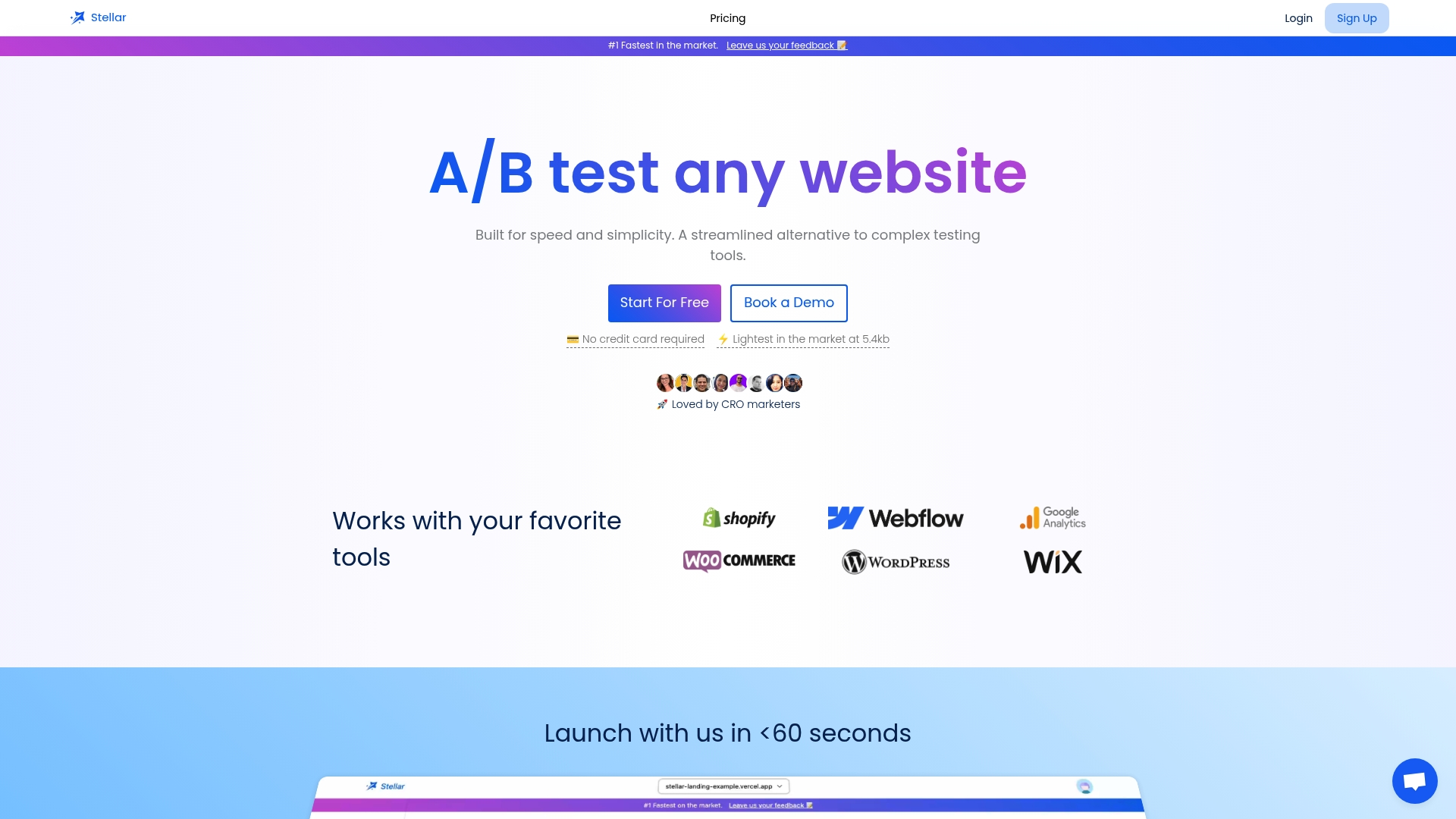
We offer a free plan for businesses under 25,000 monthly tracked users, which makes it a practical way to test the workflow before committing to anything larger. When you're ready to see it running on your own site, check out Stellar's plans and start your first experiment today.
FAQ
What does "website mobile application" mean in this context?
Here, it refers to running A/B experiments across both your website and native mobile apps, not to building a hybrid or progressive web app. The goal is testing user journeys and conversion paths on both platforms, ideally with a shared measurement approach.
How long should a cross-platform A/B test run?
Run long enough to capture at least one full weekly cycle of user behavior, since conversion patterns often shift between weekdays and weekends. If your baseline conversion rate is low or your traffic is small, loop in an analyst or engineer to confirm your test has enough statistical power before you draw conclusions.
What is interference in A/B testing and when should I worry about it?
Interference happens when one user's treatment assignment affects another user's outcome, common in social features, shared inventory, or marketplace dynamics. Research on platform experiments found spillover effects can bias results as much as the treatment effect itself, so if your product has these dynamics, consider a cluster-based design instead of a standard split test.
Do I need a developer to run tests on both web and mobile?
On web, a lightweight script paired with a no-code visual editor lets marketers launch tests without developer involvement. Mobile still typically needs an SDK or remote-config setup, though once that's in place, individual variant changes usually don't require a new app build.
What's the safest way to roll out a new experiment?
This staggered approach, well documented in marketplace and social network experiment research, lets you catch bugs or adverse effects early instead of exposing your entire audience to a broken variant at once.
Sources
- 2305.10728 Experiments on marketplaces and social networks (roll-outs and interference)
- Quantifying the Value of Iterative Experimentation (HBS working paper)
- When Does Interference Matter? Decision-Making in Platform Experiments
Recommended
Published: 10/3/2026