
WordPress A/B testing: no-code solutions for higher conversions
You've updated your WordPress landing page three times this quarter, and conversions still haven't budged. Sound familiar? Most marketers hit this wall because they're making changes based on gut feeling rather than real data. No-code plugins offer point-and-click A/B testing that lets you run real experiments without touching a single line of code. This guide walks you through every step, from picking the right tools to reading your results, so you can finally make changes that actually move the needle.
Table of Contents
- What is WordPress A/B testing and why does it matter?
- Essential plugins and tools for no-code WordPress A/B testing
- Preparation: What to test and how to set goals
- Step-by-step: Launching your first A/B test in WordPress
- Troubleshooting, mistakes, and best practices
- Verifying and acting on your test results
- Take your testing further with no-code tools
- Frequently asked questions
Key Takeaways
| Point | Details |
|---|---|
| No-code tools available | Marketers can run robust A/B tests on WordPress without any coding using visual plugins. |
| Best test practices matter | Focusing on one variable and collecting enough data ensures meaningful, actionable results. |
| Avoid common mistakes | Running overlapping or short tests undermines data reliability and outcome clarity. |
| Real results possible | Proper A/B testing can lead to impressive lifts, especially on high-traffic pages. |
What is WordPress A/B testing and why does it matter?
Framing the promise of no-code website optimization, let's clarify exactly what A/B testing is and why it should anchor your growth strategy.
A/B testing means showing two versions of a page to different visitors at the same time, then measuring which one performs better. Version A might keep your current headline, while Version B tries something bolder. Whichever drives more clicks, signups, or purchases wins. It's that straightforward.
The reason this matters so much is that it ends guesswork. Instead of debating which button color feels right in a team meeting, you let real user behavior decide. A/B testing can produce 20-50% conversion lifts when you run tests with enough traffic and a clean sample. That's not a marginal gain. That's the difference between a campaign that breaks even and one that scales.
For WordPress specifically, the opportunity is massive because of the plugin ecosystem. But there are real challenges too:
- Site speed: Poorly coded testing scripts can slow your page load, hurting both user experience and SEO rankings.
- Plugin conflicts: Running too many plugins simultaneously can create unpredictable behavior in your tests.
- SEO risk: Client-side testing tools can sometimes cause content flicker, which search engines may penalize.
- Data accuracy: Without proper setup, your analytics can misattribute conversions between variants.
Understanding why A/B test landing pages is the first step. Knowing how to do it safely on WordPress is the second.
Essential plugins and tools for no-code WordPress A/B testing
With the value of A/B testing clear, let's map out the exact tools marketers need, no developer required.
Popular no-code plugins include Nelio A/B Testing, AB Split Test, Kadence Insights, Split Hero, and PageTest.ai. Each has a different strength depending on your setup and budget. Here's a quick comparison to help you choose:
| Plugin | Best for | Visual editor | Server-side | Price range |
|---|---|---|---|---|
| Nelio A/B Testing | Full-site testing | Yes | Yes | Paid |
| AB Split Test | Page builders | Yes | No | Free/Paid |
| Kadence Insights | Kadence theme users | Yes | No | Free/Paid |
| Split Hero | Simple page splits | Limited | No | Paid |
| PageTest.ai | AI-driven suggestions | Yes | No | Paid |
For a deeper breakdown, check out this A/B testing plugin comparison that covers edge cases and advanced configurations. You can also explore the best A/B testing tools for WordPress to match your specific stack.
One distinction worth understanding is server-side vs. client-side testing. Client-side tools inject changes via JavaScript after the page loads, which can cause a visible flicker where users briefly see the original version before the variant appears. Server-side tools deliver the correct variant before the page renders, which is cleaner for both performance and SEO. If speed and data quality matter to you (and they should), prioritize server-side options.

Budget plugins work well for most SMBs starting out. Enterprise tools like Optimizely or VWO make sense only when you're running dozens of simultaneous tests across high-traffic properties and need advanced segmentation.
Preparation: What to test and how to set goals
Choosing the right tool is only step one. Knowing exactly what and how to test is where results start to happen.
Not every page deserves a test. Start with high-traffic pages and focus on one variable at a time for the most reliable results. Your homepage, primary landing pages, and checkout pages are the best candidates because they already have enough visitors to reach statistical significance faster.
Here's a prioritized list of elements worth testing:
- Headlines: The single biggest lever on any landing page. A stronger headline can double engagement before a visitor reads anything else. Learn how to test your headline effectively.
- Call-to-action (CTA) copy and color: "Get started" vs. "Start free today" can produce dramatically different click rates.
- Hero images or videos: Visual context shapes first impressions within milliseconds.
- Page layout and section order: Moving your social proof above the fold can reduce skepticism early.
- Pricing presentation: Showing annual savings upfront vs. monthly pricing affects perceived value.
Before you launch any test, write a hypothesis. It should follow this format: "If I change X, then Y will happen, because Z." For example: "If I change the CTA from 'Learn more' to 'See pricing,' then click-through rate will increase, because visitors want direct access to cost information." This forces clarity and makes your results easier to interpret.
Set one primary KPI per test. Whether that's click-through rate, form submissions, or purchases, pick one. Tracking multiple conversion elements simultaneously muddies the water and makes it harder to act on findings. For more A/B testing ideas that are proven to move metrics, build a backlog before you start so you always have a next test ready.
"The best A/B tests are boring to describe and exciting to analyze. Simple change, clear hypothesis, one metric." This mindset keeps your testing program disciplined and scalable.
Pro Tip: Run an A/A test first, where both variants are identical, to confirm your testing tool is splitting traffic correctly and reporting accurately before you invest time in real experiments.
Step-by-step: Launching your first A/B test in WordPress
With goals and ideas locked in, here's how to actually build and launch your A/B test in just a few clicks.
- Install your plugin: Go to WordPress > Plugins > Add New, search for your chosen tool (e.g., AB Split Test or Nelio), install, and activate it.
- Create your control and variant: Duplicate your existing page and make only one change in the visual editor. No code needed.
- Set your traffic split: A 50/50 split is standard for most tests. Avoid uneven splits unless you're protecting a high-revenue page.
- Connect your goal: Link the test to a specific conversion event, either through the plugin's built-in reporting or via Google Analytics goals.
- Launch and monitor: Start the test and check in every few days, but resist the urge to stop early.
Key test steps include defining your hypothesis, creating variants, splitting traffic, tracking goals, and running until you hit statistical significance, which typically means a minimum of 100 to 1,000 conversions per variant or 7 to 14 days of runtime.
| Test phase | Action | Common mistake |
|---|---|---|
| Setup | Define one hypothesis | Testing multiple changes |
| Launch | 50/50 traffic split | Uneven or biased splits |
| Monitoring | Check weekly | Stopping after 2-3 days |
| Analysis | Wait for significance | Acting on early trends |
For more split testing tips specific to WordPress, bookmark that resource before your first launch.
Pro Tip: Schedule your test to start on a Monday so your first full week of data captures a complete business cycle, including both weekday and weekend behavior patterns.
Troubleshooting, mistakes, and best practices
Even the best test can go wrong. Here's exactly how to sidestep the biggest pitfalls and ensure results you can trust.
Overlapping tests invalidate results, client-side flicker can hurt data and SEO, and low traffic requires bigger changes and more patience. These are the three most common ways a well-intentioned test produces useless data.
Other mistakes to watch for:
- Stopping tests early (p-hacking): Peeking at results daily and stopping when you see a lift is statistically dangerous. Early trends almost always reverse.
- Incorrectly segmented data: If your test runs across mobile and desktop but your variant only looks good on desktop, your aggregate numbers will mislead you.
- Ignoring external factors: A test running during a holiday sale or a major news event will produce skewed data that doesn't reflect normal behavior.
- Forgetting to document: Every test result, win or loss, is a learning. Without documentation, you repeat mistakes.
For a deeper look at advanced testing pitfalls, that resource covers real-world edge cases that most guides skip. You can also revisit the full A/B testing guide for a complete framework.
"When traffic is too low for A/B testing, qualitative tools like heatmaps and session recordings often reveal more than any split test could."
Pro Tip: Combine your A/B test data with heatmap tools like Hotjar or Microsoft Clarity. Quantitative results tell you what happened. Heatmaps tell you why.
Verifying and acting on your test results
Once your test finishes, make sure you know how to read the data and drive action from your efforts.
Statistical significance at 95% confidence is the standard threshold before declaring a winner. Most testing plugins display this automatically, but it means there's only a 5% chance your result is due to random variation rather than your actual change.
Here's how to act on different outcomes:
| Result | What it means | Next action |
|---|---|---|
| Clear winner (95%+ confidence) | Variant outperforms control | Implement winner, start next test |
| No clear winner | Difference is within noise | Run longer or test a bigger change |
| Negative result | Control outperforms variant | Keep control, learn from the data |
| Inconclusive after 30 days | Traffic too low | Combine with qualitative research |
Tests must run to significance to avoid p-hacking, even when early data looks promising. Patience here protects your conversion rate from false positives.
Once you implement a winner, document what you changed, what the result was, and what you think caused it. This builds an institutional knowledge base that makes every future test smarter. Explore proven A/B testing strategies to build a continuous testing pipeline rather than running one-off experiments. For the statistical methodology behind significance calculations, the AB testing statistics breakdown is worth bookmarking.
Take your testing further with no-code tools
Equipped with everything you need to start testing, amplify your results with automation built for marketers.
Running A/B tests on WordPress doesn't have to mean wrestling with plugins, waiting on developers, or worrying about your page speed taking a hit. Stellar's A/B testing automation is built specifically for marketers and growth hackers at SMBs who need fast, reliable experimentation without the technical overhead. The platform runs on a 5.4KB script, so your site stays fast while your tests run clean.
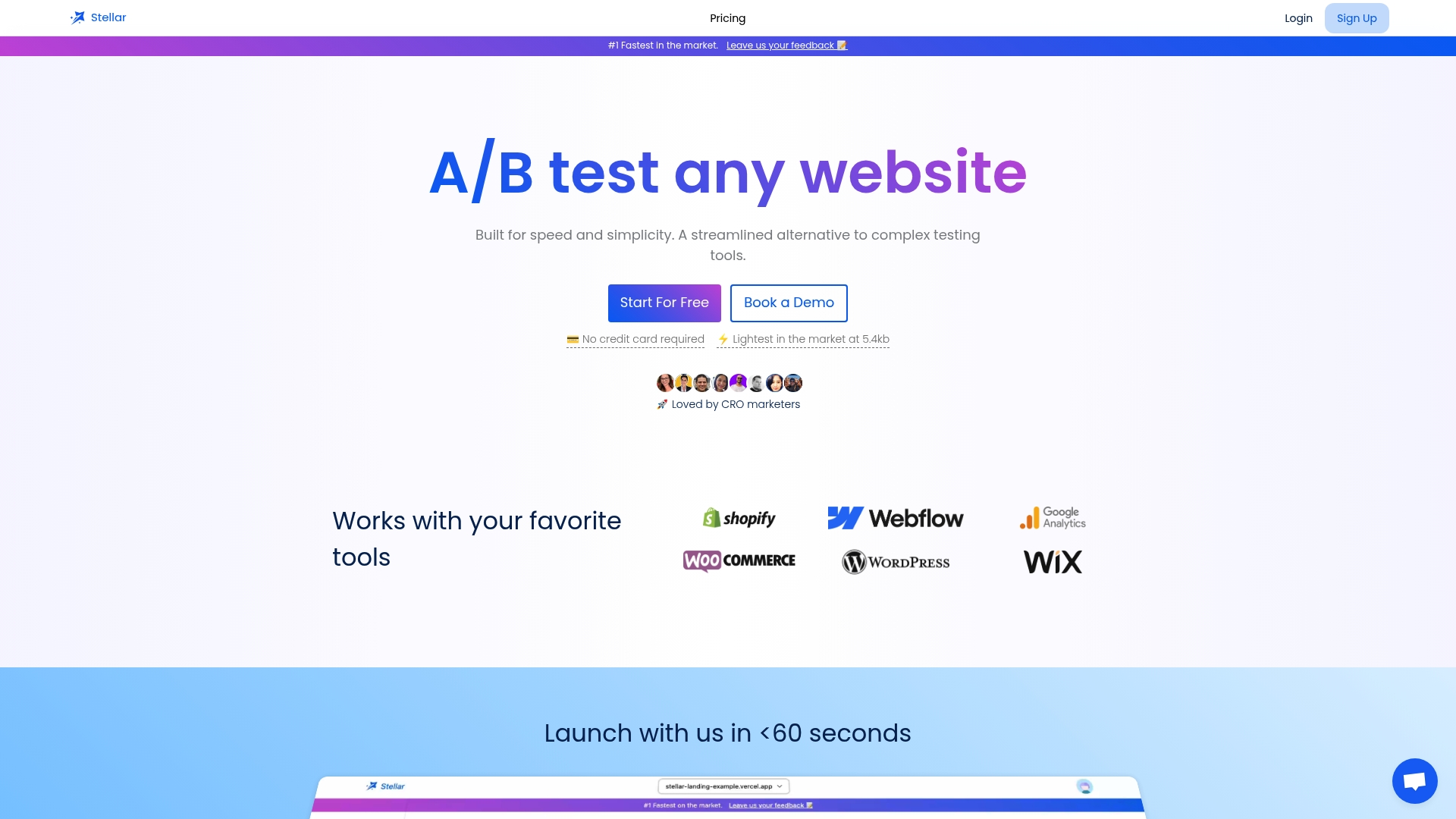
Stellar's no-code visual editor lets you build variants in minutes, and real-time analytics mean you're never waiting days to understand what's happening. Dynamic keyword insertion, advanced goal tracking, and a free plan for sites under 25,000 monthly users make it easy to start without risk. If you're serious about turning your WordPress site into a conversion machine, explore the full range of WordPress testing solutions and see how Stellar fits into your stack.
Frequently asked questions
Can I run A/B tests on WordPress without coding skills?
Yes. No-code plugins like Nelio and AB Split Test provide visual editors that let marketers build and launch tests without writing any code.
How long should I run each A/B test before making a decision?
Run tests for at least 7 to 14 days or until each variant reaches 100 to 1,000 conversions. Statistical significance requires both time and volume to be reliable.
What are common mistakes to avoid when A/B testing on WordPress?
The biggest errors are stopping tests too early, testing multiple changes at once, and running tests on pages with too little traffic. Simultaneous changes and low samples are the fastest way to get results you can't trust.
Is A/B testing always the best choice for SMBs with low traffic?
Not always. Low-traffic sites get better results by testing larger, more dramatic changes and pairing test data with qualitative tools like heatmaps or user recordings.
How do privacy and SEO factor into WordPress split testing?
Server-side plugins deliver variants before the page renders, avoiding flicker and protecting SEO. Server-side tools also handle user data more cleanly, which matters for GDPR compliance.
Recommended
- The Best WordPress A/B Testing Tools for Optimizing Your Website
- A/B Testing Without Dev Support: The Marketer's Handbook
- A/B Testing for Landing Pages: A Complete Guide
- 10 A/B Testing Ideas That Will Skyrocket Your Landing Page Conversions
- Web Design Conversion: How to Achieve Optimisation? | Kickass Online
Published: 3/30/2026